The Dying Girl

I’m a seasoned humanitarian aid worker and it takes quite a lot to upset me. Even though I moved back to Sweden I work with refugees, most of them are from Syria, so I comfort people a lot in my daily work and I hear the most horrifying stories. I keep tissues in my bag for these reasons, because women have a tendency to collapse in my arms, crying over everything lost and the horrifying things they’ve been through.

Then recently a new friend showed me a clip on his cellphone, from the underground hospital in Homs where he had worked – without formal medical training – as a nurse. Underground hospitals in Syria are run by ICRC and other organisations that treat patients impartially; in Syria it means without reporting opposition members to the Syrian regime. They operate without proper equipment, and often with staff who have little medical training. My friend had recorded quite a lot of the work in the unit and brought the movies with him to Sweden.

The footage was of good quality. Could it be useful for Swedish media? Everyone knows that there’s a civil war in Syria but few knows what it actually looks like when you’re in the middle of it. And these kinds of footages rarely make it to the international media.

I watched the clip in a coffee shop where we met during Christmas in Sweden. It was rainy and damp outside and people around us rested from their shopping sprees. I used the headphones not to disturb the other guests. I’m used to misery but I do respect people who are not.

The sounds of airplanes and bombs outside were suddenly drenched in the voice of a medical doctor. He came running with a small girl, 3 or 4 years old, in his hands, that he placed on a small bunk. But the girl wasn’t bleeding, she had no bruises, her skin was smooth and perfect. She looked like my niece that I had spent the previous day with; chubby and with her curly hair framing rosy cheeks. She seemed to be half-asleep. The girl wasn’t crying, only wailing softly. Why was the doctor in such a hurry?

“Internal injuries”, my friend said.

Then I realized: she was dying from the inside and out. The girl was in such pain that she was beyond hurting. As the doctors inserted a hose through her mouth she half-heartedly raised her hand to try and prevent it, she looked like a child who don’t want to take their medicine, nothing else. The doctor put her hand back to her side. The small natural efforts of a child to escape discomfort slowly faded. I knew what was coming before the movie was finished. I unplugged the headphones so I didn’t have to listen to it all. Life was slipping out of her by the second, under the panicky ways of the staff with sometimes little medical training in a make-shift hospital in the basement of a shabby, abandoned building in the previously so beautiful city of Homs.

Only then it struck me that there was no other people in the hospital that were worrying about the little girl than the staff. No crying mother or a father.

“She was the only survivor of that attack,” my friend confirmed. “Her mother and father, her sister, they were all gone.”

Someone was crying at the table that day, despite me not being at work. It wasn’t my friend, despite all the traumatizing things he has been through. It wasn’t anyone of the women that usually collapse in my arms when I visit one of the refugee camps. To my surprise I realized it was myself.

Christmas in Baghdad

Christmas Eve yesterday in Baghdad, Iraq. The photos are from the Iraqi photographer Ahmad Mousa, founder of the @everydayiraq project. The captions are the original ones from Ahmad Mousa’s Facebookpage.

10295015_10203869910308405_4750105813454503804_o

Iraqi Christian girls light candles on Christmas Eve at a church in Baghdad

1980466_10203868350109401_4576801807836803229_o

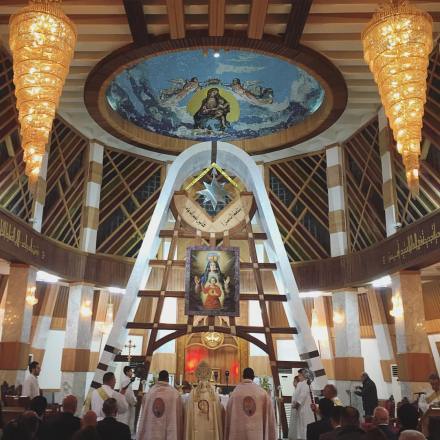
Christmas mass in Baghdad, at Our Lady of Salvation church

10386997_10203868315308531_5199901384359251384_o

Christmas mass in Baghdad, Iraq

“Iraqis and Iraqis Only Will Own This Land”

Iraq doesn’t belong to IS, Iraq never did. Don’t get fooled by the news.

If you follow anti-IS activists online you see plenty of resistance everyday, resistance that rarely make headlines in the Western news. The lack of international recognition for these activists is a reason I share these news on this web page.

This is Tourism in Iraq‘s, the page I have written about on previous occasions, latest, subtle, response to the so-called Islamic State, in form of a Facebook status update:

Iraq is the cradle of civilization with great history and magical beauty. lraqis and Iraqis only own this land.

12294908_1058223907531119_1346037794364198499_n

Photo credit: Tourism in Iraq

Iraqi Schoolgirls, Crossing a River To Go To School

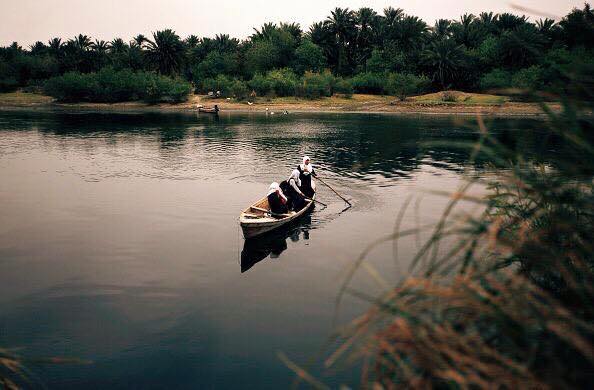
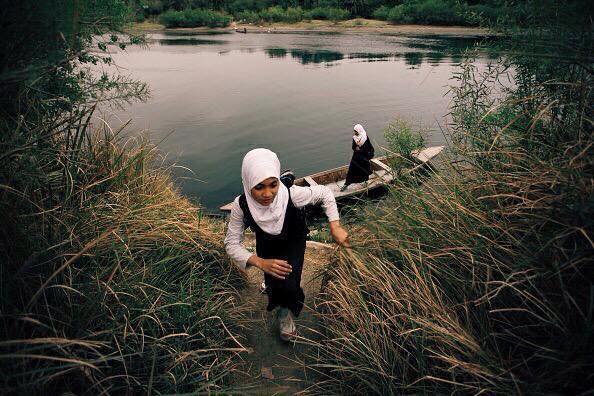
Iraqi school girls paddle a small wooden boat across a river, as they head to school.

Najaf, Iraq

12088348_1040835819269928_8886031001314180471_n

12074551_1040835799269930_3607543124984798897_n

12079527_1040835789269931_1120048001275868244_n

Photo credits: Tourism in Iraq

“When Politicians Failed to Agree on Conducting the Country’s Affairs, the Quartet Helped Them.”

151009102440-tunisia-nobel-prize-winners-2015-large-169

The Tunisian National Dialogue Quartet

Congratulations Tunisia! We were many who were overwhelmed by joy when the Tunisian National Dialogue Quartet scored the – Swedish! – Nobel Peace Prize of 2015 a few days ago. Finally, a light at the end of the tunnel!

Now, what does a Tunisian person think of this? My friend Firas, who usually is happy to share his ideas about politics, especially the Tunisian ones, gave me his ideas, in a typical Tunisian style of mixing English with French vocabulary. He was, for once, very optimistic. A trait that is not very common among Middle Eastern and North African people nowadays.

He is happy to say that the quartet deserves it:

“They negotiated for a year in order to take country to the end of the tunnel. 2012 and 2013 were tough years. Radicals were in the government, economy was down and terrorism and unemployment up. The Nobel Peace lauréates managed to make a deal, through dialogue that allowed peaceful power shift.

They lobbied and conducted a dialogue that almowed power shift from mainly islamist government to a next one made of technocrats. This lowered social tensions… Each part of this quartet represented a part of the society. When politicians failed to agree on conducting country’s affairs, the quartet helped them.”

Firas says that the quartet helped in avoiding dictatorship and power vacuum, and points out that they negotiated around nine months to facilitate the power shift to a technocrat government and to prepare for the first democratic election:

“They negotiated around nine months the power shift to technocrat government, a non-politicised one whose mission is to keep the government afloat, and prepare for the first democratic election that will bring first democratically elected government.”

I share Firas’ hopefulness too. This quartet helped Tunisia in avoiding the fate of Egypt and Libya: where sectarian tensions has taken over and terrorism replaces politics. These days I think we should celebrate the victory over terrorism, or as the player would put it: Dialogue vs Conflict: 1-0.

Photo credit: cnn.com

Beiruti Graffiti in a Time of Turbulence

10402964_10153188059712903_4009785402964153413_n

Beiruti graffiti, captured with someone’s smartphone and posted online.

Is it maybe a comment to the ongoing protests against the uncollected garbage in the city, the so called Garbage Crisis? Or is it a comment to the terrorist groups in the region, pretending to commit crimes in the name of God? Or maybe it’s just the people being fed up with not being listened to by anyone in power?

The graffiti reads, in translation:

“There is no God but the people.”

Did you get the reference?

“There is no God but God.”

Photo credit: Charbel Maydaa’s Facebook page

Alfarra Ft. Sami Bakheet: Refugee, Official Video with Lyrics

From the artist Alfa in Gaza, together with the rapper Sami Bakheet, who usually plays in Darg Team, here is the song “Refugee”.

The lyrics are on how the journey begins in Gaza, and where it ends. The reasons you have for leaving Gaza in the first place, until you meet reality.

Even if you don’t understand Arabic, I still hope you find the song nice to listen to.

Update August 5:

You can now read the subtitles in English if you click “settings” -> “subtitles” on the Youtube clip.

All About Damascus, a Sign of Normal Life

War may torment larger parts of Syria and the Middle East, but few signs of the beautiful country that once was and in some places still is, exists and pops up like butterflies here and there. One of them is the Facebook page All About Damascus, a page that started before the war, in 2010, and that is still going strong.

Today, on July 13, the page uploaded a few photos from the every day life in the colourful city of Damascus, the life that is still going on despite the war.

In the politicised debate over Syria, some might say this page is a part of the regime’s propaganda to show that they are able to reign over some parts of the country, that they are able to keep some of the city calm. But I would prefer to say it might as well be a sign of normal life. A sign to remind of what life that can remain during the dirtiest of wars.

11138662_966076513445329_7080118056154571159_n

11709247_966076116778702_985712891824170832_n

11742848_966076183445362_3578537036096338827_n

11750637_966076066778707_4011958866093648226_n

Photo copyrights: All About Damascus Facebook page 

How Do We Feel about Tunisia?

How do feel about Tunisia? Do we have the energy to gather empathy for the victims, the country, after the terrorist attack, or are we by now so numb that we will just write it off as another horrible event that seems to be the trade mark of our time?

Me myself I’m upset and sad. I have a friend in Sousse where the massacre took place and it seems that each time a terror attack happens, it’s in a place where I have close friends, and I have to send e-mails, make phone calls, send texts, to make sure everyone is ok. The negative side of having friends all over the world is the constant worry. And I would also feel less of the lack of empathy that I sometimes experience for the ever-growing terrorism worldwide. Maybe I should have stayed in Sweden and never started my travels. Maybe my life would be less worrisome then.

But feelings aside, how does this attack feel for Tunisians? We sometimes seem to forget them in the aftermath of this very attack. Therefore I asked a friend of mine, living in France, to hear what he had to say. His name is Aymen El Amri and he was once one of the initiators to the Pirate party in Tunisia. He seemed upset and sad, and said that he doubted that he would feel secure in returning to live in Tunisia, but he still wanted to share his views.

A gunman trying to kill civilians, I think it happened in some other countries around the world throughout history, but personally I have never experienced such things except in some Hollywood movies. This is new to Tunisia…

Tunisia is a small country and everything is limited there, from natural resources to police security equipment but I appreciate the fact that it has helped and provided humanitarian aid to nearly two millions Libyan refugees. But the fact of being neighbor with Libya, the civil war in this country plus the economic instability of Tunisia gave the advantage to malevolent people and groups to infiltrate to the Tunisian land, by recruitment of teenagers and trafficking of weapons.

I’ve always had a reflection of linking what is happening; IS, terrorism, attacks, bombing, to an economic; oil, gas, and geopolitical; balance of forces context. Seeing this as a religious extremism consequence is right but not enough since this is just the tip of the iceberg.

Firstly, I accuse the incompetence of the current Tunisian government – even if it is a secular government it remains incompetent – and secondly I accuse all the international “forces” that invaded Libya, supposedly to give birth to a democracy while the only change was traded equities of some oil and gas companies that increased overnight following the invasion of Libya.

For sure, I will not be 100% comfortable returning to live there and at the same time I am uncomfortable not being able to participate in getting things progress in Tunisia given the distance.

What happened is very sad but it will happen in many other countries because we’re simply living in the same world.

What stands out to me in Aymen’s reply, is that despite his country’s current sad situation and his own despairs for the future, he himself can still appreciate the help his country have been giving to two million refugees. War and terror doesn’t have to conquer empathy, at least not for everyone. Sometimes I like to be proven to be wrong.

Photo credit: uknewsroom.tk

Inside Activists against IS from Mosul, Mosul Eye, Trying to Remain active

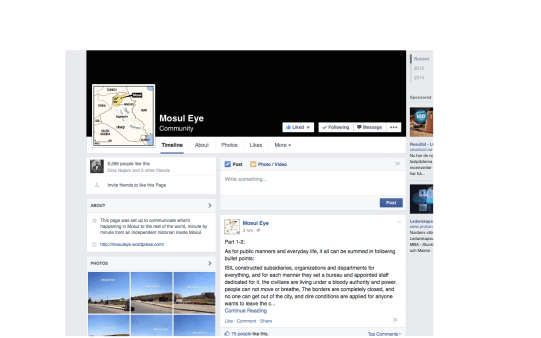
Local activists against Islamic State, behind the Facebook page Mosul eye, where they regularly publish news on how the city is ruined IS’s ruling, recently had to close down their activities, due to continuous attacks on their page. They have announced that they will reopen their page and continue to – anonymously – report about the ingoing crimes against humanity from inside Mosul. I want to share their statement here to support the activists:

“For public manners and everyday life, it all can be summed in following bullet points:

ISIL constructed subsidiaries, organizations and departments for everything, and for each manner they set a bureau and appointed staff dedicated for it. the civilians are living under a bloody authority and power. people can not move or breathe, The borders are completely closed, and no one can get out of the city, and dire conditions are applied for anyone wants to leave the city.

And ISIL issued and published these conditions, namely: 

1- hand over House mortgage ownership documents, 

2- $ 2,500 as a deposit 

3- a modern car which is manufactured no further that 2011, and 

4- a sponsor who sponsors the traveller, and for a duration of only one month. If the permission expires, the sponsor gets arrested and the house, the car and the deposit are all confiscated, and the traveller is considered to be an apostate infidel and is permitted to be killed on sight.

Kids are subjected to extreme measures of massing and incitement to all the mass murders and criminal operations ISIL leads through its media points that are scattered over the streets, and through exchanging of video clips that depict scenes of slaughter, crucifixion, burning and murder. large numbers of teenagers have been affected by ISIL’s enormous propaganda and amused by its capabilities of violence.

Lots of teens have voluntarily joined ISIL in its various ranks. Recent statistics study showed that the numbers of children volunteered into ISIL’s ranks, who were under the age of 16 years; were amounted to 370 and received religious and military training in ISIL’s camps, more than 130 children who actually participated in the battles and suicide bombings, many of them died mostly in battles for Baiji, Anbar and west of Nineveh.

ISIL imposes new strict and tough restrictions every day upon the citizens, and the last of its restrictions is men are forced to leave their beards unshaved, we already published on this page, about ISIL’s leaflet on the prevention of shaving the beard, and this is especially targeting the youth.  As for Women, ISIL is practicing extremely harsh restrictions upon them, things like wearing the veil is a must, prohibiting women from going out alone to the market unless they are accompanied with a male relative as a guardian, and as Ramadan is approaching, women are absolutely banned from leaving their houses.  Smoking is banned as well, and penalizing cigarettes vendors started at first with 70 lashes with a big fine, and now the penalty for anyone caught selling or trading cigarettes is “decapitation”!

Food prices constantly rising and will depend on whether the roads are closed with Baghdad and Kurdistan, Baghdad has recently closed the road to Mosul, and prevented the entry of large quantities of goods and foods to Mosul ISIL also imposed severe penalties on those who do not come to the mosque during prayers and closes his shop, and the penalty is confiscation of the shop with large fine and imprisonment for a whole month. Many libraries were closed, and complete banning of trading books that never call them ISIL “infidelity and apostasy books” of Arab and international novels and books of philosophy, history and literature.

In short: There are no sign of life in Mosul, I mean life in which man will be free and able to act freely and easily. The rights to live is guaranteed only by abiding by the conditions and ruthless control of ISIL and any one opposes ISIL is subjecting himself and his family to execution and confiscation of all property.

To be Continued …”