Hawzhin The Middle Eastern Feminist

Hawzhin Azeez

The Middle Eastern Feminist page singled itself out from other feminist pages on Facebook when it started up in December last year. Feminism across boundaries of ethnicity and nations; love over hate; support over anger, seemed to be the red threads for the page.

If you are struggling today, remember that you were never meant to be ashamed, depressed and guilty. You were always meant to be victorious! Don’t let the bastards grind you down,” says a quote followed by a heart from July 16.

The reconciling approach seemed to appeal to many. The page soon had many followers.

Often white, middle class women are blamed for having this approach to women’s rights as they haven’t faced real hardships themselves. But the woman behind The Middle Eastern Feminist page is not one of those.

Hawzhin Azeez’s early childhood memories consists of escaping Iraqi Kurdistan as Saddam Hussein bombed the area with chemical weapons; her pressing a scarf against her face not to breath in the lethal smoke; her mother having skin burns all over her. Living as illegal refugees in Iran the family sometimes didn’t eat for days, and on a regular basis the police came and took away her father, accusing him of being a part of the resistance against the Iranian regime due to his Kurdish ethnicity. The family never knew when or if he was coming back. In this setting there was no room for women’s rights.

“When growing up in a refugee setting, in war-torn countries, it’s incredibly hard being a woman,” says Hawzhin when explaining her upbringing and how she became a feminist. “People hold on to their ethnicity and as a young woman you’re just supposed to behave.”

After finally receiving asylum in Australia, Hawzhin and her family faced a new dilemma: the one of suddenly being in a liberal culture with new gender roles that they had no idea how to manage.

“I was going through my puberty in a family traumatized from the war,” Hawzhin says. “And we were stripped off our identity. My parents were very traditional and conservative and it was difficult for me to be friends with Australian girls. It was an isolating experience going to a Western school.”

In the Kurdish community where they lived a strong social control was being exercised. Hawzhin points out that it was first and foremost the women who exercised this control over each other and each other’s daughters. She says they had internalized the racism and sexism they had been exposed to as Kurds in the Middle East, and turned it into misogyny.

“Gossip was used a tool to limit and control each other between women. It was used to shame and guilt what women and girls did in the community.”

Despite the lack of role models, Hawzhin knew she was a feminist.

“I was born a feminist!” she says. “In Iran I witnessed things that were incredibly wrong and unjust. Religion was used as an ideology to limit the women, what they wanted to achieve. What chador means for me as a human being is that I become sexualized.”

As a teenager she was incredibly angry because she wasn’t able to live her life the way she wanted to. She read a lot of feminist literature in high school, it was her escape.

“My choices were directly linked to my family, if they agreed. I couldn’t create any issues for my family in the Kurdish community. It was a constant struggle between the community’s values and my feminism.”

Despite having arrived to Australia as an 11 year old with only two years of primary school education, Hawzhin was able to enter university after high school to study international relations and political science. But even having made it so far, she couldn’t live the way she wanted to. When she moved out of her parents’ house to do her PhD in another city at 25 years old, she was finally able to be independent. But it took a long time for her to adjust.

“I had no idea who I was. Growing up in a patriarchal family I had been constantly told how to behave and how to live. I now choose to live independently and I wish for every girl to have this freedom. Unless you do this you will never be able to make informed decisions on yourself.”

When starting The Middle Eastern feminist page it was after a long and difficult semester at university, when she was emotionally drained and spent a lot of time in front of Facebook. She noticed how people mostly posted things about what they ate and going to the gym, and wanted to turn her Facebook time into something more intellectual. Her motivation also steamed from being back in her country of origin for the first time since the escape. She went on her own without her parents and met up with her relatives. The trips were wonderful, she says, but she noticed how little women in Iraqi Kurdistan knew about their rights, and this was something she wanted to change.

“I wanted a safe place for Middle Eastern women or women from developing societies where they could talk about their rights and issues they were dealing with. But I also wanted to challenge them and tell them they could have a traditional life and still be feminists.”

Hawzhin mean that some women in the Middle East might not be able to escape their traditional life but that they can find space where they can still be feminists.

Another goal was to educate Western women on Middle Eastern women’s issues. She wanted a place for women from the two worlds to meet and realize that they were dealing with the same issues.

“Women everywhere are dealing with for example street harassment. Although the issues Middle Eastern women have are on another level, we are all struggling. I wanted to create a place for solidarity, for women to find commonalities in their lives.”

“Have you felt supported by Australian feminists or have you felt excluded?”

“Feminism in Australia is not a priority for many people… There is also a barrier between privileged women and women of color. A lot of the feminist groups and women are diffused within the political movements, there are not many groups trying to bridge the gap between privileged women and women of color, to bring all of these different identities together. But this is necessary.”

The page is now an active place for discussions and many of the over 6.000 followers are not only from the Middle East but from all over the world. Through the page connections are being made and people are making friends across boundaries. Hawzhin is actively promoting other feminist pages on her own, urging her followers to like a new page that has recently been started. She’s also sharing her private Facebook page with followers that want to add her as a friend – a page where she has posted photos of herself and her mom hugging, dressed up in Kurdish clothes, as well as photos from university parties where she’s dolled up (“I dress very femininely, I love to wear lipstick,” she says on a side note).

On combining the different cultures, she says that she sees herself as a bridge between women in Afghanistan who can’t leave the house, and urban, developed women in Egypt; that they can contribute to each other through the page.

A long message to her followers on the page from July starts like this:

I haven’t said this in a while, but: I am so incredibly in love with all you inspiring feminists (male and female), and the new ones on this page and the ones that send me private emails and share their stories, and those of you who comment and make witty and brilliant comments to posts. I know that we all come from different cultural and social settings but that does not take away from the fact that we are all struggling against a global system which thrives on the oppression and subjugation of people based on their gender or sexual orientation or race. All of our struggles matter, though the problems we face may differ somewhat.

Hawzhin has had very little negative feedback on her page and says she is shocked by the amount of support and number of women that have been contacting her. Some people expect that she’s a Muslim feminist but this is not what she calls herself.

“I call myself a secular feminist,” she says. “But if women want to cover up that’s great – I don’t believe in ripping women off their scarf.”

“Does your family know you’re a feminist?”

She laughs:

“Oh yes, very much so.”

So how are her parents, the once traumatized refugees that had such a hard time to adjust to the new society they were in, dealing with their daughter having developed to being such an outspoken feminist?

“My family has come such a long way,” she says, delighted. “There were so many things we couldn’t discuss before due to our culture, but this has changed. I am now teaching my younger sister and brother about feminism. When I visit them I always show them feminist documentaries, and my sister who is 13 comes with me to political marches. I’m teaching her to be more independent. It’s important to start with the children.”

Photo 1: Copyright Hawzhin Azeez, Photo 2: Copyright Sweden and the Middle East Views Blog
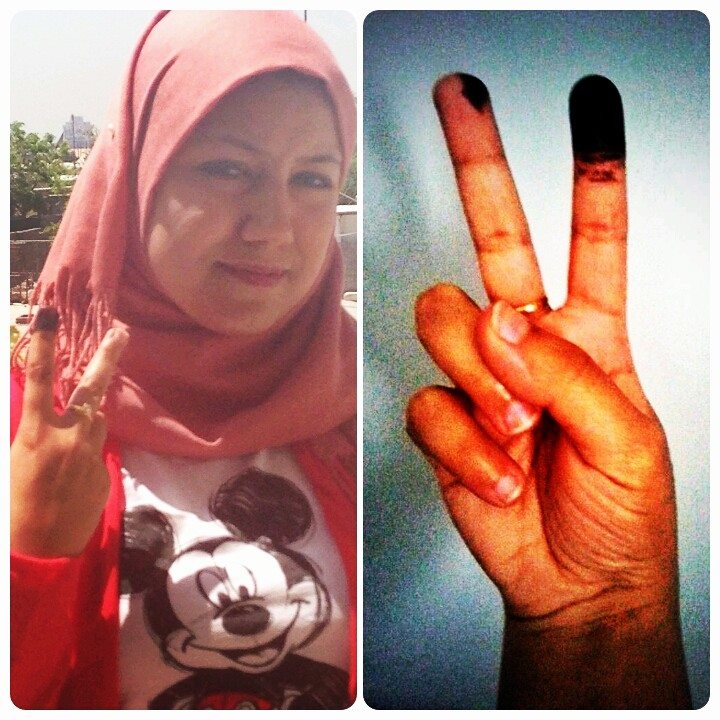
“I Am Very Happy Today Because I Believe in Change” – on the Iraqi Elections

Dina Najem

On the evening of the Iraqi elections yesterday my Facebook newsfeed was filled with Iraqi friends and aquintances who happily showed their ink coloured fingers on snapshots uploaded from smartphones. Iraq has been tormented by more violence the last weeks before the elections – still so many Iraqis seemed happy and hopeful.

I caught myself thinking, when was the last time I had a snapshot of myself on election day? That was a long time ago. The last years I have been so worried by the increasing intolerance in Sweden that I haven’t enjoyed the moment of voting.

I asked Dina Najem, women’s rights activist in Baghdad whom I previously interviewed for my blog, on her thoughts about the election and the future. She answered:

We hope in this elections we vote for new faces to be in our new parlement. We hope that they can hear our voices and we want a new Iraq. We want to build the future and change our country from the war to the new Iraq that can be developing and educating. The outcome will be better for us because we need to change and we need to achive our dream. I am very happy today because I believe in change, and all the Iraqi youth want that change.

With such a hope for the future it’s hard to stay pessimistic. I’ll borrow some of the Iraqi courage this September, when our next election is due.

Photo credit: Dina Najem

Working For US Military in Iraq – Some Reflections

DSC_0372This article was originally published on Brave New World’s website

After invading Iraq in 2003, the American troops needed assistance, and a large number of national staff was employed to help the often ill-equipped young soldiers with the cultural and linguistic challenges they faced. Being a part of the American military was often dangerous, sometimes lethal; many Iraqis who took on this mission were murdered by militias. Still local staff was easy to recruit: the jobs were well-paid and the inflation was sky-rocketing why other jobs hardly could make you earn a living.

I wanted to know how someone who was working for the Americans now is reflecting over the time served, 11 years after the invasion. And so someone put me in touch with Louis Yako.

Louis is a bit reluctant at first when we speak. He points out to me that I as a non-Iraqi will write about an Iraqi rather than the Iraqi writing the piece himself, and we end up speaking about the problematic issue of me as a white woman portraying Middle Easterners.

“When a Middle Eastern person is being interviewed it’s handled as a story,” he says.

He’s right; how often do you see a blog from the Middle East discussing Europe? But Louis still gives me the confidence to write about him and his experiences.

Even though he was only 21, with a BA in English literature from the University of Baghdad Louis was an attractive candidate for the Americans. And for him, his university had closed following the collapse of the infrastructure, and he was looking for a job.

“I didn’t understand much about was what at stake,” he says. “I wanted to practice my English, I was a young person.”

He got himself a job as a linguist in Kirkuk, one of the most violent-ridden cities after 2003; also his hometown. He spent in total two years working as a linguist, translator and local government specialist for US army, USAID and the US consulate. The duties varied but included working with the combat forces when they went to the villages to look for suspects. Two years later Louis had to leave the country:

“I was threatened personally because I worked for US army”, he says, without wanting to dwell more on the subject.

He has never been back.

Louis also had colleagues that were murdered, just like I had when working for a humanitarian NGO, even though my colleague was not killed due to his work but due to his religious belonging. We discuss this and the many Iraqis that have been killed by their fellow countrymen since 2003 when militias started their ruling by fear. But still so, and even though Louis had to flee his own country, he doesn’t want to fall into simple explanations.

“If we’re talking about the killers as ‘bad guys’ we’re using a slippery term. Nobody is truly good or evil; nobody is truly innocent or guilty. Once you call someone a bad guy; once you demonize somebody, you can easily apply your agenda on that person. We need to always understand before we use such adjectives.”

So what is his opinion now about the US invasion? He has a different take on it than the very obvious aspect of the actual war; instead the starting point to him is the many malls and American coffee shops that have popped up in no time, especially in Iraqi Kurdistan. In Erbil, mall after mall is being established to meet the needs of both local people with new money, but also the many expats that have arrived with the contracting agencies and NGOs establishing in the region, sometimes spending their salaries of lunatic standards.

“The real invasion was cultural, economic, and political,” Louis says. The military was paving the way for something much bigger than that. Real invasion is when malls, Starbucks, and other corporations of what I call the ‘transnational mafia’ mushroom, things you haven’t made with your own expertise and by your own raw materials. If you don’t understand that you’re being duped you cannot do something about it. The first step is to understand that you’re not free.” He points out: “I’m talking in a global way, not only Iraqi.”

I want to know how he sees Iraq before 2003 and he wants me to think twice about my question. He wants to shift the focus from the issue of the previous regime versus the country after the invasion:

“We are often forced to compare Iraq between the previous regime and the invasion, as if there is no other option. Let’s put that aside. Yes, Iraq was much safer and it was one nation before the war. But as for killing dissidents, for example, they kind of do that all over the world in any regime. Have a look at Snowden for example.

Iraqis could have liberated themselves, but the West’s support of the previous regime made it impossible. The West always talks about the liberation of women – that’s bullshit. Women cannot be free in a society that is occupied and not free. The ‘women card’ is always played when they want to invade a country. But women’s freedom is inseparable from men’s freedom.

As an Iraqi in the middle of the invasion you didn’t have an agency, and if you did it was because you were a convenient actor in the game. The average Iraqi in the middle of the street has nothing to say. Some voices are purposely unheard.”

We come to talk about the international aid to Iraq and how effective it really is. I ask him what kind of support he thinks the country would really benefit from.

“The concept of support from the outside needs to be reexamined,” he says. “True support can only take place when any two parties are allowed to negotiate on equal grounds.”

“In what ways?”

“Well if I have to take your ideas and they become my reality that is not support, that is very dangerous– indoctrination. So far I haven’t seen two groups treating each other equally. The withdrawal of the US troops is irrelevant; it’s the systems that are important. The soldiers are like any regular employees doing their job. They don’t have much power or say on what should happen none of them. The US presence in Iraq is not military based; it’s political, in the oil fields, in the malls. It makes Iraqis sedated consumers instead of produce what we need by ourselves.”

Now a PhD student in cultural anthropology at Duke University in North Carolina, and also an American citizen, Louis was able to get out of the dangerous situation he once was in when he received a Fulbright scholarship to Lehigh University. But he points out that he was one of few and says that it was a bottleneck, where some threatened local staff with the US army got out and some didn’t.

Still he doesn’t regret his work experience with them or the missions he carried out. What is bothering him today is that the fatal consequences of the US invasion of Iraq doesn’t seem to interest people anymore.

“The US invasion is fading away as if it didn’t happen, that’s discouraging. Not because we always want Iraq to be on the front pages but because the lessons experienced should not be forgotten, in order not to repeat the same mistakes. It’s important for humanity. International conflicts are all connected to Iraq, even before there was the invasion of Iraq, you can’t separate them. I’m totally worried that forgetting Iraq is confirming what Hegel says…”

Louis pauses and asks me if I know what Friedrich Hegel says. I don’t, so he tells me:

“‘The only thing we learn from history, is that we learn nothing from history.

Photo credit: Louis Yako

Turkish Police Brutality Silenced Online

Protesters in IstanbulJenny, please write about this in your blog! The government is doing terrible things to the people and our media is just playing mute and deaf

A Turkish friend e-mailed me today. She’s a regular Turkish young woman, uninterested in politics, who never showed any interest in activism or talking politics with me before. Attached was a link, where it said Turkish police had gassed the protesters with teargas, gassed the subway in Istanbul and an emergency room where patients of the attack had been treated. The link is now removed, as are blogs I’m trying to access- it seems the media is really being silenced from somewhere higher up.

A number of protesters had gathered in Taksim, the beautiful heart of Istanbul where protesters usually gather, to act against that the Gezi Park was to be taken down in order to give place to something else. Having known political activists in Turkey I know how the police and military usually used hard core methods when cracking down on activists – but this brutality is something new to me. Probably also to my friend, a patriot at heart, who never complained about her country before.

I will not publish the most horrific photos here as I want to keep the blog free from such pictures (you can easily find such pictures online anyway), but I’m asking you to share my blog post and these news. Turkey is a popular tourist resort that is trying to enter EU. The never ending brutality towards minorities and the population that are protesting in a peaceful, democratic way can only come to an end if the international community starts to be aware and put pressure on the current government. If Turkish bloggers can’t share the news, let us who are outside do it.