Women Owned Restaurant in Saudi Arabia Breaking New Ground

Hi Jenny – this Saudi woman could be interesting for you to write about her” my half-Kuwaiti half-Saudi friend started her email to me the other day.

In the coastal city of Dammam, Saudi Arabia, an occurence has taken place that hasn’t yet reached English international news. The Saudi woman Nora Almoqateeb was able to open a new restaurant-concept in her own name, kitchen-run by all female, despite public pressure not to. When Nora came up with the concept for the restaurant Nooryat, the first official employee receiving the application refused to give her the license to open restaurant. As Nora describes in the video (unfortunately available in Arabic only):

“He threw the file in the drawer and said ‘Are you crazy? You want to mess up the country and the women? It’s forbidden!'”

But she didn’t give up instead went to research in the local laws. She didn’t find any single Saudi law preventing her and in the end she managed to get the license, then employed Saudi women to work with her in the kitchen. She says:

“I felt I was gunpowder wanting to explode. It exploded! I was determined to get the license.”

When Nora opened the restaurant Nooryat she was afraid to go there alone. The restaurant was watched all the time by people who want to try and find small mistakes so that the restaurant could be closed down. Nora’s female worker are all Saudi, and despite being proud of their job some of them are ashamed to admit that they are working as cooks, and are afraid to give their full name. But despite the resistance Nora didn’t cave in and the staff says that they admire Nora and consider her a great female idol for all Saudi women. Nora has been so determined to carry out her business that she sometimes sleeps in the restaurant when she has a big order to deliver. In fact the word Nooryat is associated to the Arabic word for light, such as the light that lights up a house.

Along the way she had big support from her own father, and the owner of the building where to restaurant resides says:

“The main problem is that men don’t except the idea that a woman leaves her home, work in a commercial building, and cook for people”.

Now the restaurant has been nominated to the local Israr Award for 2014 – “Israr” meaning “Determination”. Let’s keep our fingers crossed she will win.

Dina – Women’s Rights Activist in Iraq

fist gallary(1)

Dina Najem became an activist after finishing her degree in French at the university in Baghdad, when she started blogging and became active in social media and realized how invisible the women were in Iraqi media.

“Iraq has always been a closed society,” she says. “Even before the US invasion the society was controlling towards women, and after 2003 there was no security at all. Women couldn’t even walk outside alone.”

Dina, now 24, decided she wanted to work for women to be able to participate more in the society.

“I have myself no support from the society” she says. “It’s my husband and my family that supports me. The government has the ability to improve the lives for Iraq’s women, they have the financial resources, but they are not doing anything.”

After a few years as an activist within local NGOs and social media Dina applied in 2012 to the Swedish Institute’s academic program for human rights activists from the Middle East and North Africa, “Social Innovation in a digital context”. She was accepted as one of 15 participants, and so was her husband Hayder, who is also an activist.

“I wanted to focus on women” she says. “Men are already dominating trainings, the political life, everything.”

She believes many women have not been fighting for their own rights.

“The war made so many stay at home, they were prevented from educating themselves. Women don´t have the knowledge to demand their rights.The one that does are not a big number.”

Lack of technical skills is another reason for the absence of women in Iraqi media according to Dina.This makes them unable to compete with men who are in the same business. With the knowledge gained on digital media from the Swedish Institutes program Dina was able to start training others.

After the six months long course she returned in April this year to Baghdad and started the photography project “Rights Without Words” for young women in the ages of 20 to 30. She went herself to look for a sponsor and got International Media Support to fund the project. By publishing information about the course online she received an overwhelming number of applications. There are obviously many young Iraqi women that want to make their spot on the media scene.

Finally Dina chose to include 22 participants instead of 15 as originally planned. The training was divided into three courses: human rights, photography and social media.

“I want to promote human rights in a creative way in my project. The participants have learned how to express themselves by photography, and how to illustrate the declaration of human rights without using any words.”

Dina has already been able to show the photos in the Iraq National Theatre, when the Iraqi musician Nasser Shamma was hosting a concert, a previously rare but nowadays more frequent happening in the capital.

Dina hopes that the world is interested of the positive development that is taking place in Iraq. She and her husband are not planning to move abroad – they want to continue with their activism despite the insecurity in Iraq. Even though she criticizes the domestic politics she thinks that there is hope in the expanding civil society. The many applicants to her project are a sign of willingness to change.

“I’m hopeful” she says. “I see so many girls that want to study and participate in everything.”

Next up in her work is to focus on women bloggers, and she also wants to work with mixed groups of young women and men. In a country where the sexes often are separated she thinks it’s crucial for women and men to work together and get to know each other.

The struggle for women’s rights is the core of her activism and she openly calls herself a feminist despite the resistance she often encounters. At the same time she is a Muslim and proud of that.

To the ones who question Dina’s commitment to human rights in a country where civilians are killed every day, she usually says:

“Well, but you can’t just sit on your chair. You have to defend your own rights.”

Rights without words

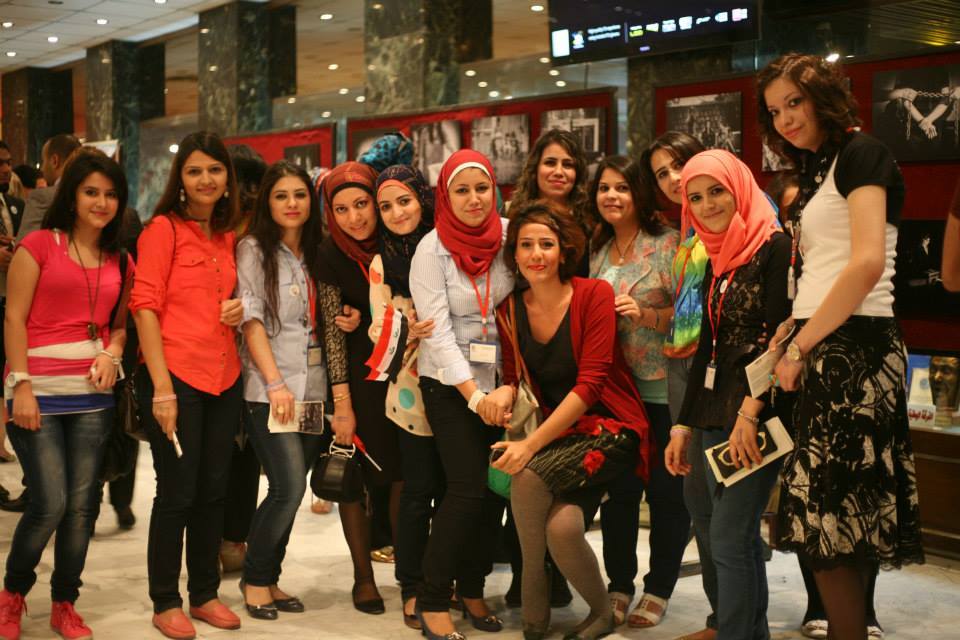
Participants in “Rights Without Words”

Photos: Copyright Dina Najem

Xena the True Lebanese Feminist

Xena Amro

This article is published in an edited, Swedish version in the feminist magazine AstraNova’s October issue 2013.

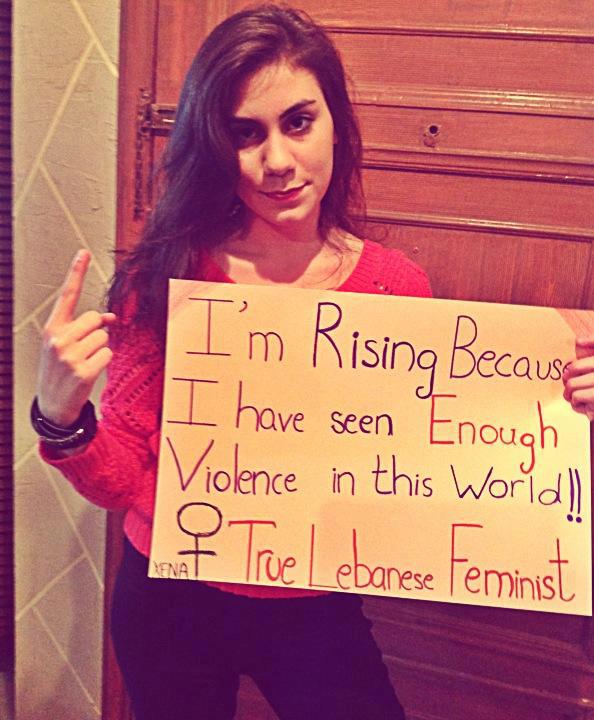
When Xena Amro started the True Lebanese Feminist Facebook page in July 2012, it created turmoil. Xena’s own Facebook page had been reported and blocked several times, so she wasn’t surprised.  On her desk in high school, random insults were written in the beginning of her school year: “Xena is stupid”,Lesbian”, “Feminism sucks ass”, reads the messages that she shows to me when we meet at Starbucks in Beirut, pictured on her smartphone.

Why was it so provoking to her fellow students that Xena was an outspoken feminist? Was it because of the success of her page? Or was it because of her uncompromising position? “I am a feminist, because those ignorant rapists out there, have limited my Freedom! They have ruined my childhood! And made me lose my mental innocence!” says one post from September 2012.

Despite the harassments in school and on the Facebook page, Xena kept up her page and now it has over 6.000 followers. She has support from both men and women, and she says she loves it especially when men become feminists:

“That’s what’s keeping me strong” she says.

Xena became a feminist early in 2012 when she was one of the winners in a competition for young writers, on the topic “In Lebanon”. “True Lebanese Feminist” was the story’s name and it was chosen to be in the top 12 list nominated for the prize. After the story and the competition, it was impossible to look back.

Xena explains on how stories about domestic violence reached her and that the general suppression against women was what made her become aware at such a young age.

“The purpose of the page is to raise awareness about women’s issues not just in Lebanon, but also globally” she says. “There are too many stereotypes placed on women that I want to fight against.”

I started to follow the page myself in the beginning and have seen it explode in to what must have been a previous vacuum, where a similar feminist page didn’t exist before. On Facebook there are many pages for women’s rights, but few that create as much discussions. What makes the page different is also that when someone attacks Xena or her statements she often don’t reply, but let the discussion have its course, relying on her supporters on the page, and makes a point out of not insulting anyone back.

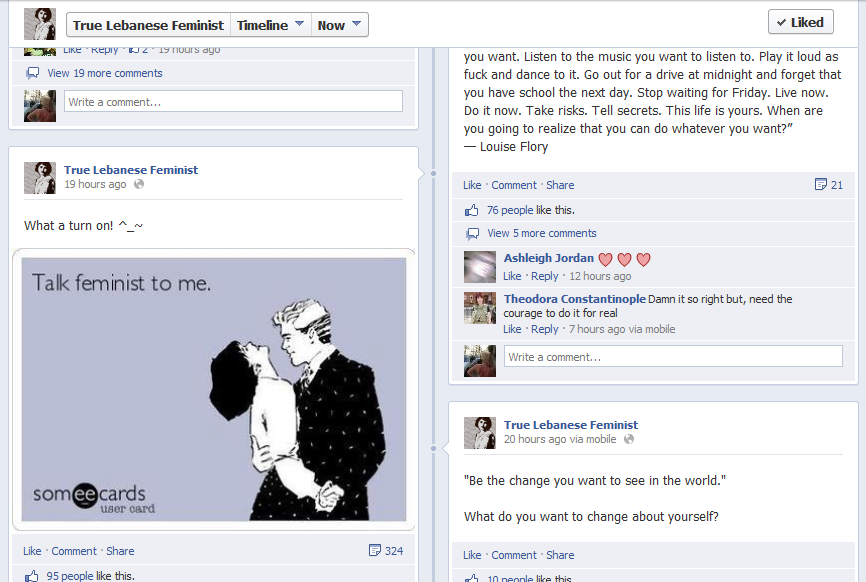
Every day the self-taught 17-year-old Xena updates the page with pictures combined with quotes; invites the followers to discussions; and shares other women’s stories. Female Arab writers like Joumana Haddad and Nawal El Saadawi inspired her. The numbers of followers quickly increased and the page turned into a place full of heated discussions. Not shying away from any subject, Xena brings up religion, sexuality and mass media from a feminist point of view:

Today is the international day for safe abortion!” reads a post with a link to “Women’s Rights to Abortion in Lebanon

True?” over a photo that states “Girls see over 400 advertisements per day telling them how they should look”.

Calling myself an outspoken dictator wouldn’t get me as much hate as I’m getting for calling myself an outspoken feminist” says another one.

Despite being as provocative in a society as Lebanon, one of Xena’s goals is to increase the number of Lebanese people on her page – out of 6,000 followers only 528 are from Lebanon (in comparison with 1,532 from US). It might not be a coincidence since her posts on religion and its links to patriarchy provokes many, and she has been accused of being a westernized atheist that hates religious people – a quite harsh insult in a society where religion plays a crucial role. Still Xena wants her page to stay relevant in her own country.

“I don’t hate religious people” she says. “They have the right to think whatever they want, and so do I – this is freedom.”

Since the beginning also emails for help has poured in. Many women from different countries have been writing to her about violence and rape, desperate for support, probably not knowing Xena is only 17. Xena takes her time to answer all emails, urging girls and women to seek help and not to feel ashamed.

I ask her how she handles it all. On top of managing the page on her own and the publicity it has given her, she gives feedback to all the members writing to her, and is also trying to finish high school to hopefully be admitted to nursing school this year. She admits that her parents, although very supportive of her feminist page, are worrying about the toll it might take on her grades.

“It takes all my free time… But the page is not pressure, it’s relief. I see a lot of injustice in the society, and I don’t want to hold these grudges in my heart.”

Photo credit: Xena Amro