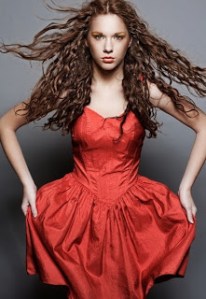
 Getting hold of Ruth Benyamin, the 67th Miss Iraq and winner of this year’s Miss Iraq competition, is not easy. The competition is no longer accepted by everyone, why in recent years Iraq’s beauty queens has stepped down one after another after death threats from hardcore religious groups, the competition had to move abroad – and Talat model agency that are handling the contest are careful. Over the course of a few months I exchange e-mails with the agency and upon request e-mail the questions that I want to ask in advance. Then all of a sudden I am in touch with the current Miss Iraq of 2013, or, as she boldly calls herself on Twitter and other social media: The Real Miss Iraq.
Ruth Benyamin was chosen in June this year after the first winner stepped down, but not due to death threats this time, according to Ruth it is because she wanted to get married – there seem to be many reasons for the Iraqi beauty queens not being able to hold on to their title. Ruth tells me that she in general is discouraged from giving interviews for security reasons, but she takes her time and writes me several e-mails with long replies to the questions. Born to an Iraqi father and a Hungarian mother, Ruth is actually one of the few Iraqis winning the last years’ competition.
“Miss Iraq is an old competition, being a titleholder is a great honor” she says. “I am the 67th titleholder, 66 previous amazing women have worn the crown, and they have represented different Iraqi ethnic backgrounds and have done well in their lives.”
This year’s competition was held in private and not advertised, why Ruth was officially crowned in a private cocktail party in Heidelberg, Germany. She explains that not many people know about the contest since the organizers keep a low profile due to the threats, and because of this, holding the crown doesn’t give her as much media attention as it could:
“The pageant itself is not a televised competition so it doesn’t get much exposure. There were attempts by organizers to sell air rights to various Iraqi TV satellite stations, but the deal were rejected as TV stations had their own reservations, plus they didn’t want to be attacked by Iraq’s hard line Shiite government.”
Her guess is that this will remain the conditions for the competition, citing the dependency on the country’s security but also the fact the modelling industry in Iraq is very limited and that there is no Iraqi fashion magazines.
Although born and raised in UK, Ruth has visited Iraq several times and have ideas about the potential development of the country. She points out that she believes the situation in Iraq will remain the same unless a three state solution is adopted; this means that apart from the already existing autonomous region of Iraqi Kurdistan, Southern/Central Iraq should be divided into two states, in order to curb the ethnic violence. She seems well acquainted with this political idea:
“Part of my work as Miss Iraq is promoting such a plan, a peaceful three-state solution. There is already a Miss Kurdistan which is treated as a contest that represents an independent country, and it’s not called Iraqi Kurdistan, for example.” Later on, when explaining why she would recommend another young Iraqi woman to participate in the competition, she adds: “You become nationalistic once you compete. We were 16 girls who competed in the 2013 edition in Mombasa-Kenya, each representing a city state. I represented Lagash (state in South-Eastern Iraq, author’s comment), we did not win local pageants, because there are no local pageants, but each candidate wears a banner of a city state and it was an amazing experience to learn about our heritage, culture and history.”
Ruth was modelling part time before being crowned Miss Iraq and is all positive about the sudden change in her life that the title has brought her:
“Talat Models has kept me busy travelling from one place to another. I have been to Dubai (where I am based, I am provided a luxury furnished apartment which I share with Miss Teen Iraq, Lina Ovadia), I have been invited by the Iraqi community in Brazil, Germany, I visited Frankfurt, Brasilia, Sao Paulo, Budapest, Rome, and I will visit Sydney and Auckland later in December… The advantages are that I get public relations training, etiquette classes, a model portfolio, public speaking.”
She hopes for a career in hotel management and believes that the work experiences she gets as Miss Iraq is beneficial for the future. As for her personal experience, she says:
“The title has shaped my personality and my perspective on life, it definitely boosted my confidence as young lady.”
Entering the contest was not only a daring decision for a young Iraqi woman, living outside Iraq is not necessarily a guarantee for safety; Ruth is also Jewish, an Iraqi minority that left the country en masse due to suppression, especially during the 1940s and 50s but also after. So what was the response from the Iraqi community on her participation?
“I guess some people like me, some don’t, so far the twitter feedbacks have been positive. Some feel because I’m Jewish that I don’t represent Iraq” she says, then adding, diplomatically: “But those are a minority.”
And diplomacy is definitely a much needed skill, when being in the sometimes dangerous position of the Iraqi beauty queen, that many of her predecessors have left in advance. The Real Miss Iraq seems to hold it up very well so far.
Photocredit: http://iraqibeauties.blogspot.com/



 Finally a change that’s not an
  Sweden and the Middle East Views