Unlearning Hate

If you hate an entire sect, group, community, region, religion, nation etc., then you have surely fallen prey to indoctrination. 

You have been taught to hate, either by your own negative experiences, or by negative experiences/perceptions of others, or by agenda-driven propaganda. 

Yes, true. You can also indoctrinate yourself (self-indoctrination) by leaving your critical faculties unused.

But, don’t worry!

A learned behavior can be changed. Just remain humble; tell yourself repeatedly that you are teachable. 

There’s no shame in unlearning falsehood and embracing universal truths.

Quote from my Pakistani friend, journalist and activist

May God Help Us, if He Exists

11173321_10205927874330800_2045869421808044113_n

I was going to write about something else, I have done research for a Middle Eastern topic, as some readers know I love the Middle East and am dedicated to write about sides of this region that usually are unnoticed in the Western media.

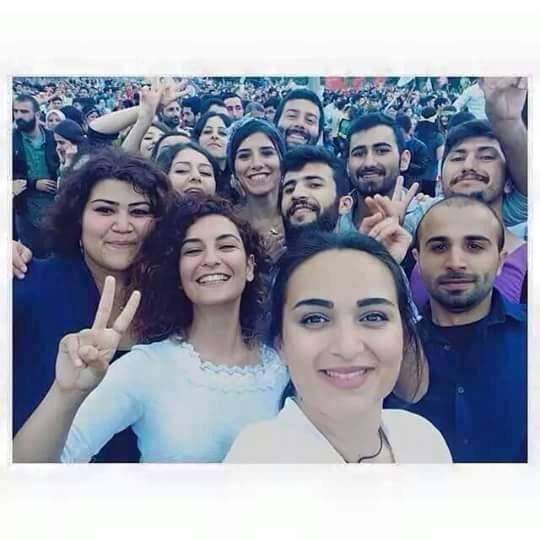
But then there was the terror attack in Turkey. This photo supposedly shows activists from the Socialist Youth Association Federation, snapping a group selfie before the bomb blast in Suruc. Turkey, the country that has sailed up from poverty and created a large middle class and that hosts a vivid civil society – now pulled back by the murder machine of we-know-who.

Before that, it was the Eid blasts all over. On a holiday that is sacred to many.

Before that, there was Tunisia, a country where I was supposed to go visit friends in a few days time, in Tunis and Sousse, only having to cancel it when Sweden’s Ministry of Foreign Affairs changed their travel recommendation.

Before that there was the Charleston massacre.

So I lost my inspiration tonight. In this very moment, this is what I feel:

I think we will remember this time as a dark turning point in history, when dark powers started to outweigh the good ones, and terrorism conquered co-existence. May God help us, if he exists.

Photo copyright: unknown

Aim Higher – Coexist. The persons behind Jews & Arabs Refuse To Be Enemies

jews and arabs front pic

Jews & Arabs Refuse To Be Enemies Facebookpage was started after the Israeli attack on Gaza and popped up on Facebook on July 10 – 16 day ago. In these 16 days the page has literally exploded with followers and people posting their own photos and comments, promoting friendship and love in a time of war. The page took many people by surprise, I included. Who were the people behind the page? I just had to find out, and the initiators were happy to share about themselves.

Abraham Gutman from Israel and Dania Darwish from Syria were classmates at Hunter College in New York and took a class in National Model United Nations together. They were both enjoying discussions about Middle Eastern politics even though they not always shared the same views.

“(We) don’t always agree but we never felt that our different opinions changed our friendship or caused any contingency between us”, Abraham says when I get in touch with them by e-mail.

They tell me that the goal of the page is to diffuse some of the hate and tension on social media platforms:

In addition, this initiative aims to create a space for civil discourse between people who identify with divergent political ideas.

I ask about how the page is a response to the current Israeli attacks on Gaza.

We feel that the escalation between Israel and Gaza caused an escalation in the language that people use on social media. In regards to the conflict, political commentary became more hateful and more violent. Unfortunately, it is easy to hide behind a keyboard and say extreme statements. Although on some things we disagree, we both believe that it is important to support a cease fire and non-violent resistance.

And how has the feedback been so far?

We got a lot of criticism from various sides of the political spectrum but we were lucky that all the criticism was civil and respectful. We did get a lot of positive feedback from Israelis, Palestinians, and many types of people that fit into different ethnic and religious groups.”

Well, not everyone likes the page. After my e-mail exchange with Abraham and Dania, there have been a few hateful messages and photos posted by others on the page. Someone has written:

Don’t tell me love between us… Love don’t exist between Arabs and Terroriste fuck you Isra-bitch”.

The same person ha uploaded a drawing of Israeli Prime Minister Benjamin Netanyahi butchering Palestinians, receiving an anti-comment from someone saying:

Aww poor Hamas, everyone is against you… stop crying, stop exploding your silly weak bombs, and Israel will stop defending Israel. It will save you some poor civilians.

But among the overwhelming photos, comments and followers on the page – 31.450 at today’s date, – probably more when you read this – those are an absolute minority. The photos consist of people of different religions and ethnicities, most Jews and Muslims, who in one way or another are doing what the states on an international level are failing to do: coexisting. Photos showing couples kissing each other; mixed families with their children; people with one Jewish and one Muslim parent; best friends hugging each other. Most are holding up sheets with hand-written statements: “Jews and Arabs Refuse to be Enemies”; “Jew, Arab, both Semitic. Most importantly, both human”; “Mother Jewish, Father Palestinian, whatever we suffer hate makes it worse”.

With the announcement of today’s ceasefire of Israel’s attack on Gaza, the Jews & Arabs Refuse To Be Enemies page uploaded the following statement:

With nearly 900 devastating deaths, a 12 hour humanitarian cease-fire is now in effect. We hope that our leaders can implement a solution in the Middle East that results in a permanent cease-fire in Israel/Palestine and an end to the siege in Gaza. The lives of all innocent civilians are too precious to be compromised by the reprehensible political nature of this conflict.

After the ceasefire, maybe the world leaders could follow the path given of the success of a simple Facebook page, the path of coexistence?

Photo credit: Jews & Arabs Refuse To Be Enemies Facebook page

Young Angry Men

angryman

Stereotypes of young angry men are often used in order to incite fear of the other – that other that is so scary to us for reasons we might not know ourselves. This is a disease so common we don’t reflect upon it. Why was for example Trayvon Martin’s murderer released if it wasn’t for that justifying fear?

I’ve been afraid myself: growing up in the capital of Sweden didn’t spare me from class related tensions, often connected to ethnicity or color, and riding on the subway made me subject of things such as sexual harassment and girls spitting me in the face. I was a blonde middle class girl for all they knew and an easy target for whatever anger they needed to vent. And yes, I was afraid of young men, especially of color, who seemed angry.

Later on when I was grown and graduated university I worked as a substitute teacher while I hoped a job opening would come through. I took on jobs in the projects as the social aspect of teaching appealed to me. The job contained a lot more of steering off violent teenagers and spending time on the phone to the social services than what it contained teaching, and it was draining at times but I was dedicated and stayed on. In one school I had a particularly violent student, one of those who would have scared me when I was younger, a 13 year old boy that we can call Mostafa.

On good days Mostafa was happy with merely stabbing a sharpened pen in his school desk while repeating every word the teacher said in a mocking voice. The whole school seemed to be afraid of him. I dreaded classes with him but always tried to keep my cool. That plus a dose of discipline and kindness was my way of dealing with the students.

“I’m gonna destroy your presentation, you fucking bitch!” was one of his opening lines, to which I usually replied “Oh, really”, which always left him puzzled for a few seconds.

But despite our efforts to teach the kids we teachers never asked ourselves what the anger came from. We didn’t seem to have the energy to do the math of alienation, substandard housing, poverty. Isn’t that the fault of the whole society?

Now Mostafa was the child of immigrant parents from a Middle Eastern country and I mentioned once to the students that I had lived in his parents’ country of origin. Mostafa didn’t comment upon it but other kids asked me of the few words I had picked up in Arabic and Mostafa overheard it all. One day he banged on the door and demanded to be let in when I was preparing a class. He positioned himself on a desk and started to talk to me about his parent’s home country, as if he wanted to verify that it was really true I had lived there. We had a small conversation where he asked questions such as “Did you have friends there?” (“Yes, I did”), before he went out again.

After that day he slowly changed his behavior in my class. He stopped mocking me when I spoke. He stopped throwing things across the classroom. He tried to finish his exercises and left his desk to show me that he was writing (“Great, Mostafa. You’re doing really well”). Then the school semester came to an end, so did my temporary contract and the next semester I was teaching at a different school.

One evening there was a festival in our city and I was out with a friend to listen to some live music. When we approached the hiphop scene I suddenly heard a teenage voice calling my name:

“Jenny, Jenny!”

It was Mostafa, whom I hadn’t seen since the end of the last semester. He had spotted me from the audience stage and suddenly stood above me.

“Hi Mostafa!” I answered with a smile, pleased to see him.

Back then I often – and I still actually do – ran in to former students who were happier to see me outside school than they had ever been seeing me inside of it. When bumping in to each other downtown many wanted to talk a little and tell me about their lives; some simply said hi; the most hardcore ones usually just nodded in recognition or ignored me. Not wanting to talk was to me understandable, as some of them dropped out of school and joined gangs, and this is nothing you want to admit to your former teacher. But nothing of what I could have expected had prepared me for Mostafa’s response that day: he jumped off the stage, threw himself in my arms, and buried his head in my shoulder. Perplexed I hugged him for a few amazing seconds.

“How are you? I’m fine! I gotta go!” He said all in once and then freed himself from my embrace, suddenly realizing what he had done; the hug of a former teacher in front of his friends, then set off and ran away.

I never saw him again, later on I heard that he was one of the kids to drop out of school, but I will never forget the hug that day. It changed my previous perception of young and angry men. In that very moment, the angry Mostafa whom everyone was so afraid of, was nowhere in sight.

Photo credit: mahwaff.com

What Mandela Meant to My 5-year-old Me

Can I tell you what Nelson Mandela meant to my 5-year-old me, back in the early 80s?

Once my sisters and I were shopping with our dad in the grocery store. He didn’t want to buy the apples from South Africa, asking us to choose from the other shelf instead, and we demanded to know why. And so he started to explain.

There was a country far, far away, where some people were treated differently than the others. Therefore us in other countries should not buy their things, so that they would understand what they did was wrong. This was a tricky thing to explain for three small girls with one million questions, but dad didn’t give up.

“It would be like… if Maria (their friend’s daughter) wouldn’t be allowed to sit on the same bus as you”, he explained, as he trailed us through the store with a shopping cart filled with unflavored cereal and other boring groceries that characterized Sweden in the 1980s. “Or if someone was sick, and the hospital wouldn’t let them in.”

The story haunted me. A few years later the front pages posted the news on Mandela’s was release. One of my friends’ father explained what the headlines were about, as we passed by the placards.

These stories must have affected my in a way I didn’t realize. And yes, feelings of anger and sadness followed as a result of knowledge. But I am glad adults were willing to take their time explaining things, instead of sugarcoating it. Small things like these shaped me into the person I am today. It made yesterday, to me, a special day.

First Saudi Policewoman Ever to Graduate!

ayat bakhreeba

Yesterday the world suddenly became a little better place to live – a Saudi woman graduated from the Dubai police academy, and according to the news she is the first Saudi woman ever to become a police officer!

Leaving few traces of herself online and unknown to international media before her graduation, Ayat Bakhreeba did not only become the first Saudi police officer ever. According to Riyadhconnect.com and other Gulf media, Ayat Bakhreeba is graduating in public law with a thesis research on children’s rights in the Saudi regime – a brave subject in a totalitarian regime. For a country that systematically discriminates women and children, this woman is taking a small step on the moon; which is a big step for humanity. Not that I’m surprised with the Saudi women, not at all. Things are shaking up in the kingdom.

Photo credit: Emirates247.com

Dina – Women’s Rights Activist in Iraq

fist gallary(1)

Dina Najem became an activist after finishing her degree in French at the university in Baghdad, when she started blogging and became active in social media and realized how invisible the women were in Iraqi media.

“Iraq has always been a closed society,” she says. “Even before the US invasion the society was controlling towards women, and after 2003 there was no security at all. Women couldn’t even walk outside alone.”

Dina, now 24, decided she wanted to work for women to be able to participate more in the society.

“I have myself no support from the society” she says. “It’s my husband and my family that supports me. The government has the ability to improve the lives for Iraq’s women, they have the financial resources, but they are not doing anything.”

After a few years as an activist within local NGOs and social media Dina applied in 2012 to the Swedish Institute’s academic program for human rights activists from the Middle East and North Africa, “Social Innovation in a digital context”. She was accepted as one of 15 participants, and so was her husband Hayder, who is also an activist.

“I wanted to focus on women” she says. “Men are already dominating trainings, the political life, everything.”

She believes many women have not been fighting for their own rights.

“The war made so many stay at home, they were prevented from educating themselves. Women don´t have the knowledge to demand their rights.The one that does are not a big number.”

Lack of technical skills is another reason for the absence of women in Iraqi media according to Dina.This makes them unable to compete with men who are in the same business. With the knowledge gained on digital media from the Swedish Institutes program Dina was able to start training others.

After the six months long course she returned in April this year to Baghdad and started the photography project “Rights Without Words” for young women in the ages of 20 to 30. She went herself to look for a sponsor and got International Media Support to fund the project. By publishing information about the course online she received an overwhelming number of applications. There are obviously many young Iraqi women that want to make their spot on the media scene.

Finally Dina chose to include 22 participants instead of 15 as originally planned. The training was divided into three courses: human rights, photography and social media.

“I want to promote human rights in a creative way in my project. The participants have learned how to express themselves by photography, and how to illustrate the declaration of human rights without using any words.”

Dina has already been able to show the photos in the Iraq National Theatre, when the Iraqi musician Nasser Shamma was hosting a concert, a previously rare but nowadays more frequent happening in the capital.

Dina hopes that the world is interested of the positive development that is taking place in Iraq. She and her husband are not planning to move abroad – they want to continue with their activism despite the insecurity in Iraq. Even though she criticizes the domestic politics she thinks that there is hope in the expanding civil society. The many applicants to her project are a sign of willingness to change.

“I’m hopeful” she says. “I see so many girls that want to study and participate in everything.”

Next up in her work is to focus on women bloggers, and she also wants to work with mixed groups of young women and men. In a country where the sexes often are separated she thinks it’s crucial for women and men to work together and get to know each other.

The struggle for women’s rights is the core of her activism and she openly calls herself a feminist despite the resistance she often encounters. At the same time she is a Muslim and proud of that.

To the ones who question Dina’s commitment to human rights in a country where civilians are killed every day, she usually says:

“Well, but you can’t just sit on your chair. You have to defend your own rights.”

Rights without words

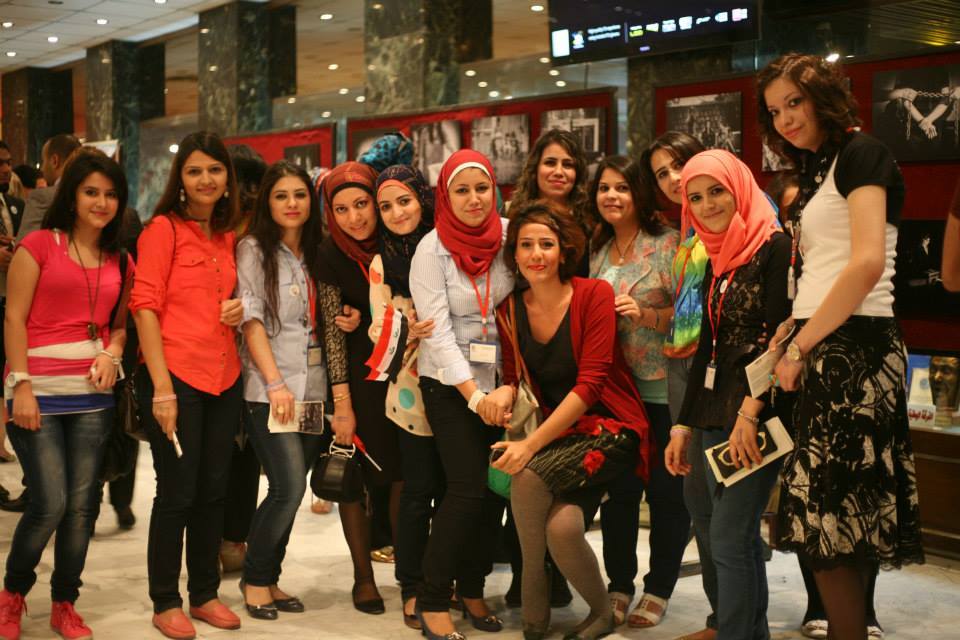
Participants in “Rights Without Words”

Photos: Copyright Dina Najem

Ruth Benyamin – The Real Miss Iraq 2013

Getting hold of Ruth Benyamin, the 67th Miss Iraq and winner of this year’s Miss Iraq competition, is not easy. The competition is no longer accepted by everyone, why in recent years Iraq’s beauty queens has stepped down one after another after death threats from hardcore religious groups, the competition had to move abroad – and Talat model agency that are handling the contest are careful. Over the course of a few months I exchange e-mails with the agency and upon request e-mail the questions that I want to ask in advance. Then all of a sudden I am in touch with the current Miss Iraq of 2013, or, as she boldly calls herself on Twitter and other social media: The Real Miss Iraq.

Ruth Benyamin was chosen in June this year after the first winner stepped down, but not due to death threats this time, according to Ruth it is because she wanted to get married – there seem to be many reasons for the Iraqi beauty queens not being able to hold on to their title. Ruth tells me that she in general is discouraged from giving interviews for security reasons, but she takes her time and writes me several e-mails with long replies to the questions. Born to an Iraqi father and a Hungarian mother, Ruth is actually one of the few Iraqis winning the last years’ competition.

“Miss Iraq is an old competition, being a titleholder is a great honor” she says. “I am the 67th titleholder, 66 previous amazing women have worn the crown, and they have represented different Iraqi ethnic backgrounds and have done well in their lives.”

This year’s competition was held in private and not advertised, why Ruth was officially crowned in a private cocktail party in Heidelberg, Germany. She explains that not many people know about the contest since the organizers keep a low profile due to the threats, and because of this, holding the crown doesn’t give her as much media attention as it could:

“The pageant itself is not a televised competition so it doesn’t get much exposure. There were attempts by organizers to sell air rights to various Iraqi TV satellite stations, but the deal were rejected as TV stations had their own reservations, plus they didn’t want to be attacked by Iraq’s hard line Shiite government.”

Her guess is that this will remain the conditions for the competition, citing the dependency on the country’s security but also the fact the modelling industry in Iraq is very limited and that there is no Iraqi fashion magazines.

Although born and raised in UK, Ruth has visited Iraq several times and have ideas about the potential development of the country. She points out that she believes the situation in Iraq will remain the same unless a three state solution is adopted; this means that apart from the already existing autonomous region of Iraqi Kurdistan, Southern/Central Iraq should be divided into two states, in order to curb the ethnic violence. She seems well acquainted with this political idea:

“Part of my work as Miss Iraq is promoting such a plan, a peaceful three-state solution. There is already a Miss Kurdistan which is treated as a contest that represents an independent country, and it’s not called Iraqi Kurdistan, for example.” Later on, when explaining why she would recommend another young Iraqi woman to participate in the competition, she adds: “You become nationalistic once you compete. We were 16 girls who competed in the 2013 edition in Mombasa-Kenya, each representing a city state. I represented Lagash (state in South-Eastern Iraq, author’s comment), we did not win local pageants, because there are no local pageants, but each candidate wears a banner of a city state and it was an amazing experience to learn about our heritage, culture and history.”

Ruth was modelling part time before being crowned Miss Iraq and is all positive about the sudden change in her life that the title has brought her:

“Talat Models has kept me busy travelling from one place to another. I have been to Dubai (where I am based, I am provided a luxury furnished apartment which I share with Miss Teen Iraq, Lina Ovadia), I have been invited by the Iraqi community in Brazil, Germany, I visited Frankfurt, Brasilia, Sao Paulo, Budapest, Rome, and I will visit Sydney and Auckland later in December… The advantages are that I get public relations training, etiquette classes, a model portfolio, public speaking.”

She hopes for a career in hotel management and believes that the work experiences she gets as Miss Iraq is beneficial for the future. As for her personal experience, she says:

“The title has shaped my personality and my perspective on life, it definitely boosted my confidence as young lady.”

Entering the contest was not only a daring decision for a young Iraqi woman, living outside Iraq is not necessarily a guarantee for safety; Ruth is also Jewish, an Iraqi minority that left the country en masse due to suppression, especially during the 1940s and 50s but also after. So what was the response from the Iraqi community on her participation?

“I guess some people like me, some don’t, so far the twitter feedbacks have been positive. Some feel because I’m Jewish that I don’t represent Iraq” she says, then adding, diplomatically: “But those are a minority.”

And diplomacy is definitely a much needed skill, when being in the sometimes dangerous position of the Iraqi beauty queen, that many of her predecessors have left in advance. The Real Miss Iraq seems to hold it up very well so far.

Photocredit: http://iraqibeauties.blogspot.com/

Who Cares About a Dead Iraqi Anyways?

On a week like this, when 55 persons in Baghdad has been killed by bombs in a vegetable market; outside a mosque and in residential areas, I feel with the Iraqis, and I feel with the families of the assassinated civilian people that happened to be in the wrong place at the wrong time. The 55 persons of yesterday were not the only ones: last month almost 1.000 people were killed all over Iraq.

And I’m relieved that I’m not working for an Iraq mission as I have in the past, even though safely tucked away in the comfort of Kuwait or Iraqi Kurdistan. Relieved because I don’t have to work Skype and the phone to make sure none of my Iraqi colleagues are among the murdered. Because what would happen if they were?

No one would be hunted down by the local police and tried in front of the justice system, where they would get their rightful punishment, that in turn would discourage others from committing the same crime. No office or NGO would close for the day or a minute of silence be demanded in order to respect the dead. No debriefing would be given to the other staff to help them cope with the loss. Work would carry on as normal and the organization would send their condolences to the family while starting the recruitment process for someone new. Years back in an Iraq mission, my expat colleague whose team member was taken from his own house under gunpoint by one of the many militias, and tortured for hours before being killed, was left on her own to choke back tears in front of her laptop after the murder. Because who cares about a dead Iraqi anyways?

The colleague of ours was actually a person, a real human being. He happened to be friendly and everyone in the office liked him. He had a family that loved him, a mother and a father, sisters and brothers that missed him deeply when he was gone. But in the eyes of many he was a nobody, just another dead Iraqi. I rest quite assured things remain the same for the Iraqis whose lives are lost today.

Campaign for Domestic Worker’s Rights in Kuwait

Human Rights Watch has launched Campaign for Domestic Worker’s Rights. The campaign is illustrated with photos of Arab women dressed in the costumes that many of the workers have to wear when on duty – which often is 15 hours per day, 7 days a week. Hopefully this will make people think.

I have repeatedly become surprised over how people’s brains stop working when exposed to something abnormal being normal – Arabs, Europeans, Americans alike – which is what the trafficking situation of poor people from Asia and Africa to the Middle East is today. I won’t dig into the subject of why you can’t clean your own house or raise your own kids, but on how today’s knowledge about human rights for some people seem to have vanished.

When living in Kuwait I had a friend from Eastern Europe who had married an Arab man residing in the country. She was a great girlfriend; caring, funny and smart, and I missed her a lot when moving. Going back to visit a few years later, she and her husband had got their first child and employed a live-in-maid, and suddenly I saw a new side of her. The woman they had employed, let’s call her Maria, was not allowed to call my friend and her husband by their first names, instead ”sir” and “maam”.

“If you let them call you by your name they will disrespect you, you can’t give them too much freedom,” my friend explained.

All house chores had been given to Maria who worked from 6 am to 10 pm without a break. She was not allowed go out on her own or make her own decisions about what to do during the day, had to follow my friend wherever she went, walking a few steps behind with all the bags and the trolley that she pushed the toddler in, when my friend was out with her girlfriends on one of their many shopping tours to the mall.

My friend thought she was nice to Maria. She could eat how much she wanted and slept in a bed in the child’s playroom – “Not on the floor like with the Kuwaiti families”. My friend didn’t seem to reflect on how Maria might feel when my friend called her stupid or criticized her for not doing anything right (I noticed this among many, the constantly criticizing of the domestic staff, as if they get a kick out of putting them down).

Now I happened to like Maria as a person and we spent some time talking. It turned out she had a university degree in her Asian home country and previously had a qualified job that she had lost, why her last way out if keeping her own child in a private school was to go abroad as a domestic worker. The experience had been a shock and she found herself not able to return as she had signed a two year contract and had her passport taken away. I suggested I ask my other friends about jobs in her field of experience and we secretly exchanged numbers. My research didn’t lead to anything but we kept in touch after I left. She often called and texted, feeling so alone and exposed.

Then a few weeks later my friend’s husband emailed me. My friend had taken Maria’s mobile to check on her and had read my messages. She and her husband were furious I had kept in touch with Maria and urged her to get a better job. This is an excerpt from the e-mail:

I would really like to thank you for treating your friends who were soo good, honest, loveable to you and accepted you in their home not as a guest but as a very close person. We are very surprised of the way you cheated us and tried to contact our nanny from our back and tried to help her to leave us and finding a job because you persuaded her that she’s over qualified to be a nanny…  If you think that you are supporting women right by encourage her to do what she did and leave us then let me tell you that you destroyed our lovely family and destroyed her life as well.

He ended the e-mail by telling story I had heard before, on how Maria had felt so empowered by me that she had brought home a man and had sex with him in a room next to where the child had been sleeping. The story is one version of many used to justify what happens if you give your maids “too many rights”; Asians are not only unintelligent, they are also sexually primitive if you fail to control them. Do you know your history? African–Americans were once considered the same way by whites.

My friend blocked me on all social websites we had been in touch through and we never spoke again. I don’t know what happened to Maria – the control must have increased and I assumed it was safer for her not to be in touch with me as I anyways was far away from Kuwait and had no means of helping her.

Human Rights Watch’s campaign is much needed in a time when again human rights doesn’t apply to people of color, and I wish it leads to some sort of change. If I could speak to my friend I would explain to her why I had urged Maria to leave and that I hadn’t mean to hurt my friend – but I wouldn’t say I’m sorry. And if I were in the same situation I would do what I did again, even if it meant losing a close friend. I know some people would say I’m fanatic. I say I’m normal.

Photocredit: Human Rights Watch