Why I Love Syrian Girls

In a time when Syria is associated mostly with conflict, I’d like to take the opportunity to tell about something that I like with this country: my girlfriends. Now I’m not usually prone to generalizations, but I have found that my Syrian friends have quite a few characteristics in common, so why not share them? (And hey, who is a woman without her girlfriends anyways?)

Girls, I love you cause you are…

  • Openminded and curious
  • Trustworthy, if you say you will pick me up at 7 you’re at my door 7 sharp, no flaking out
  • Stylish and cool, always dressed up, willing to lend out your clothes or braid my hair
  • Complimenting on my looks in a way that makes me feel good. No “Did you gain weight?”-rudeness here
  • Fun-loving in a carefree way, when going out with you anything can happen

Ladies, this one’s for you! Keep staying cool no matter where your country is heading.

Small Boys Waiting to Be Men, Kuwait

Photo: Copyright Sweden and the Middle East Blog

Campaign for Domestic Worker’s Rights in Kuwait

Human Rights Watch has launched Campaign for Domestic Worker’s Rights. The campaign is illustrated with photos of Arab women dressed in the costumes that many of the workers have to wear when on duty – which often is 15 hours per day, 7 days a week. Hopefully this will make people think.

I have repeatedly become surprised over how people’s brains stop working when exposed to something abnormal being normal – Arabs, Europeans, Americans alike – which is what the trafficking situation of poor people from Asia and Africa to the Middle East is today. I won’t dig into the subject of why you can’t clean your own house or raise your own kids, but on how today’s knowledge about human rights for some people seem to have vanished.

When living in Kuwait I had a friend from Eastern Europe who had married an Arab man residing in the country. She was a great girlfriend; caring, funny and smart, and I missed her a lot when moving. Going back to visit a few years later, she and her husband had got their first child and employed a live-in-maid, and suddenly I saw a new side of her. The woman they had employed, let’s call her Maria, was not allowed to call my friend and her husband by their first names, instead ”sir” and “maam”.

“If you let them call you by your name they will disrespect you, you can’t give them too much freedom,” my friend explained.

All house chores had been given to Maria who worked from 6 am to 10 pm without a break. She was not allowed go out on her own or make her own decisions about what to do during the day, had to follow my friend wherever she went, walking a few steps behind with all the bags and the trolley that she pushed the toddler in, when my friend was out with her girlfriends on one of their many shopping tours to the mall.

My friend thought she was nice to Maria. She could eat how much she wanted and slept in a bed in the child’s playroom – “Not on the floor like with the Kuwaiti families”. My friend didn’t seem to reflect on how Maria might feel when my friend called her stupid or criticized her for not doing anything right (I noticed this among many, the constantly criticizing of the domestic staff, as if they get a kick out of putting them down).

Now I happened to like Maria as a person and we spent some time talking. It turned out she had a university degree in her Asian home country and previously had a qualified job that she had lost, why her last way out if keeping her own child in a private school was to go abroad as a domestic worker. The experience had been a shock and she found herself not able to return as she had signed a two year contract and had her passport taken away. I suggested I ask my other friends about jobs in her field of experience and we secretly exchanged numbers. My research didn’t lead to anything but we kept in touch after I left. She often called and texted, feeling so alone and exposed.

Then a few weeks later my friend’s husband emailed me. My friend had taken Maria’s mobile to check on her and had read my messages. She and her husband were furious I had kept in touch with Maria and urged her to get a better job. This is an excerpt from the e-mail:

I would really like to thank you for treating your friends who were soo good, honest, loveable to you and accepted you in their home not as a guest but as a very close person. We are very surprised of the way you cheated us and tried to contact our nanny from our back and tried to help her to leave us and finding a job because you persuaded her that she’s over qualified to be a nanny…  If you think that you are supporting women right by encourage her to do what she did and leave us then let me tell you that you destroyed our lovely family and destroyed her life as well.

He ended the e-mail by telling story I had heard before, on how Maria had felt so empowered by me that she had brought home a man and had sex with him in a room next to where the child had been sleeping. The story is one version of many used to justify what happens if you give your maids “too many rights”; Asians are not only unintelligent, they are also sexually primitive if you fail to control them. Do you know your history? African–Americans were once considered the same way by whites.

My friend blocked me on all social websites we had been in touch through and we never spoke again. I don’t know what happened to Maria – the control must have increased and I assumed it was safer for her not to be in touch with me as I anyways was far away from Kuwait and had no means of helping her.

Human Rights Watch’s campaign is much needed in a time when again human rights doesn’t apply to people of color, and I wish it leads to some sort of change. If I could speak to my friend I would explain to her why I had urged Maria to leave and that I hadn’t mean to hurt my friend – but I wouldn’t say I’m sorry. And if I were in the same situation I would do what I did again, even if it meant losing a close friend. I know some people would say I’m fanatic. I say I’m normal.

Photocredit: Human Rights Watch

A Cup of Water in the Conflict Zone

The other day I had spilled food on my hand when eating outside and needed to wash it. In a street corner a man sold candy and chewing gums from cardboard boxes. I had seen him before as I passed the corner every day, it was close to my work place in Damascus. In the morning I saw him coming and loading the boxes with the unsold items from the day before – overnight he covered the boxes and the wobbly tables the boxes were placed on with different pieces of fabric tucked together. The man was sitting on the side of the street, I approached him and asked for a “small bottle of water”.

“I don’t sell water.”

Of course, the little stall didn’t have a fridge, how could he sell any drinks? It had been a stupid question to ask.

“Aha, ok. Sorry.”

I turned to leave.

“But, wait…”

He remembered something, got up and went over to the tables, started rummaging around among the fabric. He picked up a box of clean paper cups and a big bottle of water, his own water, then poured me a cup. I fetched my wallet with my other not-so-greasy-hand and picked up some coins.

“Thank you, how much is it?”

“Nothing.”

Some weeks before I had been ripped off in a grocery store, paying twice as much as I should, and when I realized I couldn’t be particularly mad. Most people would rip anyone off if they were on the brink of poverty, especially a foreigner who had much more, in a time when the country’s currency was falling dramatically until the previously big-bills turned small-bills turned nothing. I wanted to pay and insisted, offering the coins. Suddenly the man looked sad. Just sad.

“I don’t want any money. Please take it, my daughter.”

That made me quiet. I mumbled a thank you. In that little moment, kindness won over war. It’s not a small power, not a sign of weakness. I believe it can sometimes be very strong.

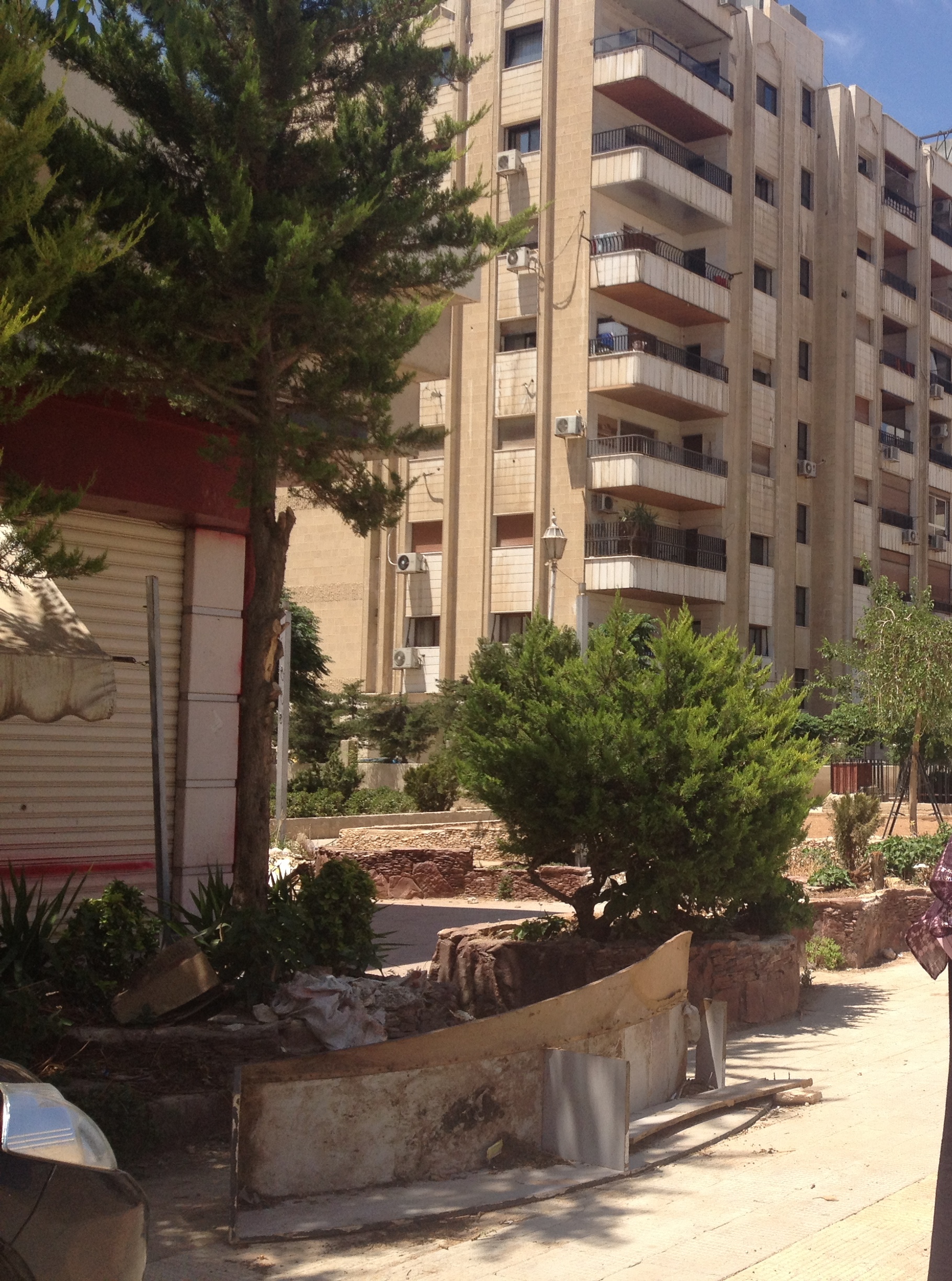
Summer in Damascus Suburbs

IMG_0137

Photos: copyright Sweden and the Middle East blog

Turkish Police Brutality Silenced Online

Protesters in IstanbulJenny, please write about this in your blog! The government is doing terrible things to the people and our media is just playing mute and deaf

A Turkish friend e-mailed me today. She’s a regular Turkish young woman, uninterested in politics, who never showed any interest in activism or talking politics with me before. Attached was a link, where it said Turkish police had gassed the protesters with teargas, gassed the subway in Istanbul and an emergency room where patients of the attack had been treated. The link is now removed, as are blogs I’m trying to access- it seems the media is really being silenced from somewhere higher up.

A number of protesters had gathered in Taksim, the beautiful heart of Istanbul where protesters usually gather, to act against that the Gezi Park was to be taken down in order to give place to something else. Having known political activists in Turkey I know how the police and military usually used hard core methods when cracking down on activists – but this brutality is something new to me. Probably also to my friend, a patriot at heart, who never complained about her country before.

I will not publish the most horrific photos here as I want to keep the blog free from such pictures (you can easily find such pictures online anyway), but I’m asking you to share my blog post and these news. Turkey is a popular tourist resort that is trying to enter EU. The never ending brutality towards minorities and the population that are protesting in a peaceful, democratic way can only come to an end if the international community starts to be aware and put pressure on the current government. If Turkish bloggers can’t share the news, let us who are outside do it.

Lava and the Swedish Beauty Salon

Lava Marof at her university graduation

I first heard about Lava when given a ride by a young man in Erbil, Iraqi Kurdistan, after a job meeting.

“My cousin is also from Sweden”, he said. “She moved back here with her Swedish husband a while ago and opened a beauty salon”.

Not knowing many Kurdish girls marrying to Swedish men, I was hesitant to believe it. But Erbil is like a village despite its size, and many people mentioned Lava and her beauty salon. After an incident at a hair salon where my haircut came out awful, I scanned the city for someone to fix it, and found a salon called En-Vy behind shaded doors in the area Ainkawa. In the back of the salon was a girl in hip square glasses, mixing colors and chatting in Kurdish. It happened to be Lava that people were talking about; a Kurdish girl from Sweden who spoke my dialect of Swedish. I became a regular customer at En-Vy’s, their style being so different. En-Vy was a place for many open-minded women to hang out and drink coffee while having hair extensions inserted for the weekend or makeup done before weddings. After a while I also got to know more about Lava.

Deciding to move back to Kurdistan with her family in 2004 after graduating from high school, to a city someone described as “the Wild West” – at that time there were hardly no streets, bars or cafés – Lava Marof was determined to be a part of the process of rebuilding her country.

“I felt like wow, I can be a part of building this country”, she tells me on Skype from Malaysia, where she now lives.

She held down several jobs; one of them at Ministry of Education, revising the English material for schools, and she pursued her university studies at the same time. It wasn’t easy being a girl from Sweden, obviously independent.

“Your daughter is out all the time”, the neighbors would complain to Lava’s mother.

“She’s out all the time because she has three jobs”, the mother would reply.

“Why does she need to have three jobs?” the neighbors would ask, puzzled. “Is she not going to get married?”

Nevertheless Lava stayed put. She was proud of being Kurdish and determined to be a part of the newly independent Kurdistan Autonomous Region. After graduating from Salahaddin University she went back to Sweden where she met her future husband to be, Alex. Quickly she decided to bring him to Kurdistan to visit her family.

“I told Alex he had to ask my father for my hand”, she said. “There are certain things in my culture that are precious and that I want to maintain.”

They married and moved together to Erbil. Alex free-lanced within digital media and Lava fulfilled her dream of opening a beauty salon with European standard, importing all products from Italy, the staff being both men and women. I asked how this was possible with many veiled customers.

“Some accept the male staff cutting their hair, some don’t, and they might go somewhere else”, Lava said, also explaining that the shaded doors protected from view from the outside and that male customers was not welcome – this mix between conservative and Western oriented customer service obviously being enough to keep a large group of women coming to the salon.

As it has not been to walk her own path between two countries and cultures, I ask Lava about the worst thing she has experienced and she retells a story on how she and Alex together with a group of friends checked in to a resort in Rawanduz. The receptionist demanded to see the marriage certificate, and upon seeing it, asked Lava if there had been no Kurdish men left for her so that she was forced to marry to a European. Lava snapped back: ‘Yeah right, since all Kurdish men are thinking like you’.

“Sometimes you just have to show who’s in charge”, she concludes.

Photo credit: Lava Maroof

Women

There are many perceptions about women in the Middle East among us in the Western part of the world, me included. I’ve come across quite a few cool women during my travels that has turned my own ideas upside down. So I thought, why not introduce a few women that I know, that got something to tell us?

Stay tuned for the first post in this category, coming soon…