The Liberation Might be Close – and Then?

img_2304

IS are being pushed further and further, and many are already celebrating the victory over one of the worst terrorist organisations – at least one of the worst who’s been able to show it off so cleverly online – this decade.

What will happen after IS might finally succumb in Iraq and  its scattered members go on the run to avoid being tortured by the general army’s forces? What will happen after its European members will go back to their respective countries and plan terrorist attacks back home?

This is what needs to happen:

Iraqi government needs to include minorities in their politics. They need to take safety measures so that  minorities can live under the same conditions as the majority population.

Public schools needs to receive sufficient funding and teachers so that all children get a substantial education.

The national army and police needs to be trained so that they don’t repeat the human rights abuses that has been conducted towards civilians.

Otherwise, the same constellation, or a new one, will pop up sooner or later. And the celebrations will be silenced for good.

#SyriaB4War – Hashtag Gone Wrong

image2

UNHCR Northern Europe wanted to launch a hashtag on Syria to remind people on how Syria was before the war. Little did they probably suspect that Syrian activists – these admirable, young, brave people – would take over the hashtag to remind the world of what was going on behind the beautiful scenery of their homeland. UNHCR even happily encouraged twitters to publish their photos of Syria before the war, seemingly disregarding the Syrian activists using Twitter as their main forum for resistance towards the regime.

Everyone agrees that Syria was a beautiful country before the war, but if you happened to be against the regime, to be one of those who wanted to speak, read and write whatever they wanted to, Syria could show a very ugly face. This, many people seem to have forgotten by now. The Twitter activists quickly took the opportunity to remind of this, and to show an excerpt of their remarkably dark humour:

“#SyriaB4War: is where you have to watch the criminal dictator pictures in all streets” (attached, a photo with the ever-smiling Bashar Al Assad)

“#SyriaB4War: Farm for Bashar al-Assad and his family”

“#SyriaB4War: Thousands of writers and the opposition were in prison”

“#SyriaB4War: is where the civil society activism was only for Asthma Assad and her entourage”

“#SyriaB4War: is where families dream of eating meat without being able to fulfil that dream with their miserable salaries”

image1

And the last touché: one twitterer attached a photo of the Tadomour prison in Syria: “who goes there never return”.

image3

I bet UNHCR’s communication department will think twice next time.

The Forgotten, Beaten and Tired Syrian Activists

I remember the beginning of the Syrian revolution. Young Syrians; girls in their pastel-colored clothes that marked the spring of 2011; young men in leather jackets protecting them against the chilly March weather.

They were so cool. They were hopeful. They were saying things in public that previously had made you, if you happened to be in Syria, shiver. They were forming cells; established independent news outlets; traded news about which activist was in which underground prison; helped kids who had become orphans when their parents disappeared; speaking openly about the sexual abuse the female members of the opposition endured in prison.

The activists that I knew were journalists, medical doctors, university scholars, NGO employees by day; activists by night. Keeping in touch with other fellow activists on social media and the in the Middle East so loved Blackberry.

The topics of politics and justice flowed easily among them; sitting with some Syrian activists, they always started talking politics, you could break night with them just to hear their ideas, their bright thoughts about the future, when their generation would be the first one to conquer the long-lived illness of living under a totalitarian regime. They would bring up their kids in a society where you could say whatever you liked. Where fear didn’t seep in everywhere. Where the beautiful, amazing country of Syria didn’t have that silenced cover over it all: where freedom prospered. Where you could talk as openly in the street as you could a few hours away from Damascus, on the other side of the border in Lebanon.

And soon we are at the five year landmark. In a few weeks it’s March 2016. What happened to the cool young Syrian activists, with their high-flying dreams? The one who were chanting in the streets?

My own answer is so sad that I have to write about it.

The Syrian activists that I know are tired and beaten and worst of all, forgotten. No one will assign them with a human rights award. No one will call them on a stage in front of an international audience and praise them for all the brave things they did for their own country. How they started free press online. How they cared for other people’s children. How they treated wounded civilians with a minimum of medical supplies.

The Syrian activists, the ones who started it all, before Daesh, before Al Nosra front, before the foreign interventions, are in worst case dead; tortured and starved until they caved in in one of the regime’s dreaded dungeons. If they’re better off, they’re released and living in constant fear of being detained again. Leaving the country starts to become more and more impossible for those who are still left.

If they’re better off they have been able to leave the country and are scattered around the globe, refugees in other countries. They are often unwelcome.  They’re struggling with psychological problems many can’t imagine. They are depressed, suffering from anxiety attacks, insomnia. And being traumatised doesn’t always make you a better person. Being traumatised doesn’t make you nicer. It makes you angry, and you take out the anger on anyone. It makes you bitter and you take out the bitterness on anything.

The mental health care system in my own country often can’t cope with their traumas. Psychologists I’ve heard of break down in tears themselves when hearing the horrific ordeal the Syrian regime put the activists through, the civil war that tore the country in pieces.

Being a Syrian activist in 2016 – you’re forgotten. The pastel colours from the spring of 2011 has faded a long time ago. The activists were left with no support and here we have the results. What’s left is a regional war, a war by proxy, that’s escalating into an international war, in a place where the so promising feelings of hope and trust once grew.

Photos of Tishrin Dam, Liberated from IS

12489435_1045438268852402_5505383862670668372_o.jpg

IS announcing their rule

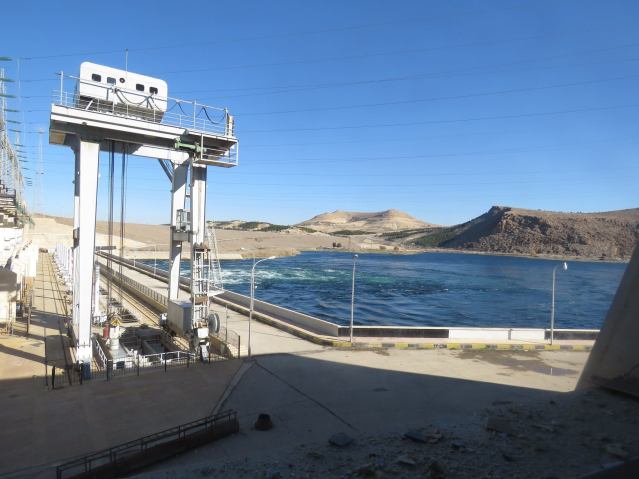
IS are facing setbacks, pushed back by mainly the moderate Syrian opposition. One of the areas liberated from IS Tishrin Dam, a dam that supplies areas in Northern Syria; Syrian Kurdistan, with water. It was the Syrian Democratic Forces, a coalition group of different factions fighting the Syrian regime, that were able to capture the dam from IS, making them loose a strategic position.

12471544_1045437782185784_3882741674072119525_o

12419054_1045438768852352_4667380816620246223_o

The dam

An international group that is dedicated to the reconstruction of Kobane and areas that were destroyed by IS, Kobanê Reconstruction Board, recently went to visit Tishrin dam, and the member Hawzhin Azeez, also the woman behind the page The Middle Eastern Feminist, shared these photos and allowed them to be republished here. The only photos not republished are those portraying corpses. This is Hawzhin Azeez’s description of the visit:

“I am sharing some late images of Tishrin dam when we visited a few days after its liberation. Tishrin was liberated on the 26th of December by the Syrian Democratic Forces (SYD) after being under Daesh control for over two years.

Tishrin is an incredible dam, not least of all because of the fact that it sits cradled in a beautiful lush valley, in an otherwise dry and arid land. But also because of what Tishrin implies for the people of Rojava who have survived for the past two years under incredible economic and political conditions, exacerbated significantly by lack of access to water and electricity which Tishrin provides.

12493950_1045438718852357_4911020520329843728_o

Tishrin dam’s 6 water turbines can be seen here

Daesh’s terrorism extended to not only physical violence and terror but also a deliberate and comprehensive policy of destroying or taking key infrastructure and service buildings. Make no mistake Daesh is a great strategist and despite issues with the lower rank terrorists the organisation has caused significant and long term damage to Rojava through its calculated infrastructural damage. This also included extensive placement of hand made booby traps, mines and other unexploded ordinances.

10653350_1045436708852558_1711153727245732775_n

Booby trap making supplies

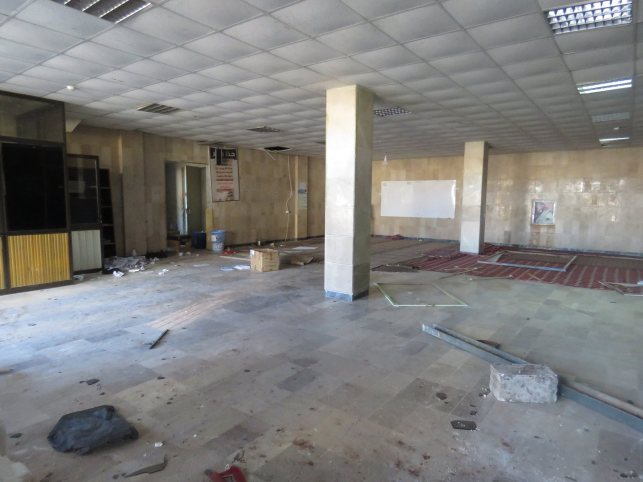
Inside Tishrin, Daesh had created an “education center” for children- literally a terrorist training centre, including small child sized Qurans. One of the pamphlets left over detailed the fact that members could take any women among the population so long as they received the emir’s permission.
12466149_1045438735519022_3249839738173216248_o

12525609_1045438668852362_1059899025947576449_o

The children’s training room

Another notable room was the “Palace Room” where the Emir would receive his guests, a grand room that now lay tattered following the fierce battle to liberate Tishrin.

12491805_1045438832185679_1345084187315673690_o

The palace room 

Tishrin city, now resembling an eerie ghost town, was empty of the Emirs and their families and supporters. On the streets children’s bikes, baby strollers and even passports lay scattered. The only reminder across the dam and the city was painted black signs of Dash flag but also, the dozens of dead Daesh bodies (luckily they did not smell too much as they were still relatively fresh corpses but also because of the cold winter) across the streets and the city. In one of the streets there were remnant of booby trap making supplies left.

Finally, at the end of the tour of the city we came across an Arab family, who tentatively came forward initially and then proceeded to hug and kiss us. The family had three daughters, two in early 20s and one that was perhaps no older than 15. The mother told us that she had hid her daughters for over two years in the basement of her house in fear of them being taken by Daesh. I hugged the girls who smiled back shyly as the hevals checked the village homes for remaining Daesh members. Their sweet shyness hid what horrors they may have experienced or what they had to do to survive under the two long years their family was terrorised by Daesh. The hevals told us that they had found a Daesh member, who claimed to be only a driver for Daesh hiding under a car the afternoon before.

A few days after our visit Daesh had launched a second offensive in a futile attempt to recapture the dam. Many have died defending her, but liberating Tishrin has brought Rojava a significant and decisive step forward towards consolidating her revolutionary goals and objectives. We are working hard to ensure that Tishrin provides services again asap to the people of Kobane and Rojava. For us, Tishrin represents and symbolises hope and life, liberation and self-sufficiency.”
 

12484585_1045438695519026_8967051290300754201_o

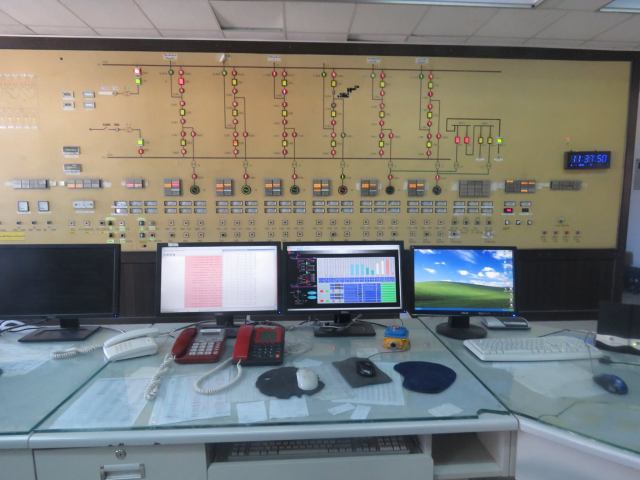
Control room of the dam

12489210_1045438638852365_289545056480062204_o

The Kobanê Reconstruction Board having lunch with the engineers of Tishrin who had continued to run the dam under IS. The visiting group were asked not to show the faces of the men for security reasons.

Photo copyrights: Hawzhin Azeez

The Dying Girl

I’m a seasoned humanitarian aid worker and it takes quite a lot to upset me. Even though I moved back to Sweden I work with refugees, most of them are from Syria, so I comfort people a lot in my daily work and I hear the most horrifying stories. I keep tissues in my bag for these reasons, because women have a tendency to collapse in my arms, crying over everything lost and the horrifying things they’ve been through.

Then recently a new friend showed me a clip on his cellphone, from the underground hospital in Homs where he had worked – without formal medical training – as a nurse. Underground hospitals in Syria are run by ICRC and other organisations that treat patients impartially; in Syria it means without reporting opposition members to the Syrian regime. They operate without proper equipment, and often with staff who have little medical training. My friend had recorded quite a lot of the work in the unit and brought the movies with him to Sweden.

The footage was of good quality. Could it be useful for Swedish media? Everyone knows that there’s a civil war in Syria but few knows what it actually looks like when you’re in the middle of it. And these kinds of footages rarely make it to the international media.

I watched the clip in a coffee shop where we met during Christmas in Sweden. It was rainy and damp outside and people around us rested from their shopping sprees. I used the headphones not to disturb the other guests. I’m used to misery but I do respect people who are not.

The sounds of airplanes and bombs outside were suddenly drenched in the voice of a medical doctor. He came running with a small girl, 3 or 4 years old, in his hands, that he placed on a small bunk. But the girl wasn’t bleeding, she had no bruises, her skin was smooth and perfect. She looked like my niece that I had spent the previous day with; chubby and with her curly hair framing rosy cheeks. She seemed to be half-asleep. The girl wasn’t crying, only wailing softly. Why was the doctor in such a hurry?

“Internal injuries”, my friend said.

Then I realized: she was dying from the inside and out. The girl was in such pain that she was beyond hurting. As the doctors inserted a hose through her mouth she half-heartedly raised her hand to try and prevent it, she looked like a child who don’t want to take their medicine, nothing else. The doctor put her hand back to her side. The small natural efforts of a child to escape discomfort slowly faded. I knew what was coming before the movie was finished. I unplugged the headphones so I didn’t have to listen to it all. Life was slipping out of her by the second, under the panicky ways of the staff with sometimes little medical training in a make-shift hospital in the basement of a shabby, abandoned building in the previously so beautiful city of Homs.

Only then it struck me that there was no other people in the hospital that were worrying about the little girl than the staff. No crying mother or a father.

“She was the only survivor of that attack,” my friend confirmed. “Her mother and father, her sister, they were all gone.”

Someone was crying at the table that day, despite me not being at work. It wasn’t my friend, despite all the traumatizing things he has been through. It wasn’t anyone of the women that usually collapse in my arms when I visit one of the refugee camps. To my surprise I realized it was myself.

“Iraqis and Iraqis Only Will Own This Land”

Iraq doesn’t belong to IS, Iraq never did. Don’t get fooled by the news.

If you follow anti-IS activists online you see plenty of resistance everyday, resistance that rarely make headlines in the Western news. The lack of international recognition for these activists is a reason I share these news on this web page.

This is Tourism in Iraq‘s, the page I have written about on previous occasions, latest, subtle, response to the so-called Islamic State, in form of a Facebook status update:

Iraq is the cradle of civilization with great history and magical beauty. lraqis and Iraqis only own this land.

12294908_1058223907531119_1346037794364198499_n

Photo credit: Tourism in Iraq

I Still Don’t Share Photos of Murdered IS Terrorists. At Some Point This Still Needs to End.

After the Paris massacre a photo popped up in my Facebook news feed, signed the Kurdish security forces, Peshmerga, that I follow. A photo of a murdered young man, clearly shot dead while on the move, probably fleeing for his life. His face is frozen in a frightened expression, his hands curled up in spasms, his face covered in blood.

In front of him another young man is peeking in to the camera and cheekily sticking out his tongue. The photo caption reads “Gift of the Peshmerga heroes to French people“.

The comments are almost exclusively overwhelmingly joyous and sarcastic:

“Nice shot”

“Stay Frosty”

“He’s throwing ISIS gang signs LOL”

I didn’t hit the like button for this photo. I didn’t share it. I did consider potentially stop liking Peshmerga forces, despite the information the page provides me.

It might be obvious to you why I reacted like this, but to sum it up, here’s the comment from the one follower of the page, a young man too and I believe he is Kurdish, who did not agree:

By posting this you bring shame on the Kurdish people.
We should not be driven by hate, but by humanity and our love to freedom.

If only more young men were thinking like him.

I have never and will never share photos of murdered or injured or caged IS terrorists. We might be approaching the third world war, we might be in the middle of it, but at one point, this still needs to end. And peace will not come faster by seeking revenge and mocking the dead ones.

I will not be the person to prolong the wait.

The Fighting

744px-Lebanese_French_flag.svg

The fighting over flags is ridiculous.

The fighting over who suffers the most is ridiculous.

The fighting over where people come from is ridiculous.

The fighting over refugees is ridiculous.

We are all tired, afraid.

We all want to live.

Photo credit: Wikipedia.org

“When Politicians Failed to Agree on Conducting the Country’s Affairs, the Quartet Helped Them.”

151009102440-tunisia-nobel-prize-winners-2015-large-169

The Tunisian National Dialogue Quartet

Congratulations Tunisia! We were many who were overwhelmed by joy when the Tunisian National Dialogue Quartet scored the – Swedish! – Nobel Peace Prize of 2015 a few days ago. Finally, a light at the end of the tunnel!

Now, what does a Tunisian person think of this? My friend Firas, who usually is happy to share his ideas about politics, especially the Tunisian ones, gave me his ideas, in a typical Tunisian style of mixing English with French vocabulary. He was, for once, very optimistic. A trait that is not very common among Middle Eastern and North African people nowadays.

He is happy to say that the quartet deserves it:

“They negotiated for a year in order to take country to the end of the tunnel. 2012 and 2013 were tough years. Radicals were in the government, economy was down and terrorism and unemployment up. The Nobel Peace lauréates managed to make a deal, through dialogue that allowed peaceful power shift.

They lobbied and conducted a dialogue that almowed power shift from mainly islamist government to a next one made of technocrats. This lowered social tensions… Each part of this quartet represented a part of the society. When politicians failed to agree on conducting country’s affairs, the quartet helped them.”

Firas says that the quartet helped in avoiding dictatorship and power vacuum, and points out that they negotiated around nine months to facilitate the power shift to a technocrat government and to prepare for the first democratic election:

“They negotiated around nine months the power shift to technocrat government, a non-politicised one whose mission is to keep the government afloat, and prepare for the first democratic election that will bring first democratically elected government.”

I share Firas’ hopefulness too. This quartet helped Tunisia in avoiding the fate of Egypt and Libya: where sectarian tensions has taken over and terrorism replaces politics. These days I think we should celebrate the victory over terrorism, or as the player would put it: Dialogue vs Conflict: 1-0.

Photo credit: cnn.com

Beiruti Graffiti in a Time of Turbulence

10402964_10153188059712903_4009785402964153413_n

Beiruti graffiti, captured with someone’s smartphone and posted online.

Is it maybe a comment to the ongoing protests against the uncollected garbage in the city, the so called Garbage Crisis? Or is it a comment to the terrorist groups in the region, pretending to commit crimes in the name of God? Or maybe it’s just the people being fed up with not being listened to by anyone in power?

The graffiti reads, in translation:

“There is no God but the people.”

Did you get the reference?

“There is no God but God.”

Photo credit: Charbel Maydaa’s Facebook page