Dina – Women’s Rights Activist in Iraq

fist gallary(1)

Dina Najem became an activist after finishing her degree in French at the university in Baghdad, when she started blogging and became active in social media and realized how invisible the women were in Iraqi media.

“Iraq has always been a closed society,” she says. “Even before the US invasion the society was controlling towards women, and after 2003 there was no security at all. Women couldn’t even walk outside alone.”

Dina, now 24, decided she wanted to work for women to be able to participate more in the society.

“I have myself no support from the society” she says. “It’s my husband and my family that supports me. The government has the ability to improve the lives for Iraq’s women, they have the financial resources, but they are not doing anything.”

After a few years as an activist within local NGOs and social media Dina applied in 2012 to the Swedish Institute’s academic program for human rights activists from the Middle East and North Africa, “Social Innovation in a digital context”. She was accepted as one of 15 participants, and so was her husband Hayder, who is also an activist.

“I wanted to focus on women” she says. “Men are already dominating trainings, the political life, everything.”

She believes many women have not been fighting for their own rights.

“The war made so many stay at home, they were prevented from educating themselves. Women don´t have the knowledge to demand their rights.The one that does are not a big number.”

Lack of technical skills is another reason for the absence of women in Iraqi media according to Dina.This makes them unable to compete with men who are in the same business. With the knowledge gained on digital media from the Swedish Institutes program Dina was able to start training others.

After the six months long course she returned in April this year to Baghdad and started the photography project “Rights Without Words” for young women in the ages of 20 to 30. She went herself to look for a sponsor and got International Media Support to fund the project. By publishing information about the course online she received an overwhelming number of applications. There are obviously many young Iraqi women that want to make their spot on the media scene.

Finally Dina chose to include 22 participants instead of 15 as originally planned. The training was divided into three courses: human rights, photography and social media.

“I want to promote human rights in a creative way in my project. The participants have learned how to express themselves by photography, and how to illustrate the declaration of human rights without using any words.”

Dina has already been able to show the photos in the Iraq National Theatre, when the Iraqi musician Nasser Shamma was hosting a concert, a previously rare but nowadays more frequent happening in the capital.

Dina hopes that the world is interested of the positive development that is taking place in Iraq. She and her husband are not planning to move abroad – they want to continue with their activism despite the insecurity in Iraq. Even though she criticizes the domestic politics she thinks that there is hope in the expanding civil society. The many applicants to her project are a sign of willingness to change.

“I’m hopeful” she says. “I see so many girls that want to study and participate in everything.”

Next up in her work is to focus on women bloggers, and she also wants to work with mixed groups of young women and men. In a country where the sexes often are separated she thinks it’s crucial for women and men to work together and get to know each other.

The struggle for women’s rights is the core of her activism and she openly calls herself a feminist despite the resistance she often encounters. At the same time she is a Muslim and proud of that.

To the ones who question Dina’s commitment to human rights in a country where civilians are killed every day, she usually says:

“Well, but you can’t just sit on your chair. You have to defend your own rights.”
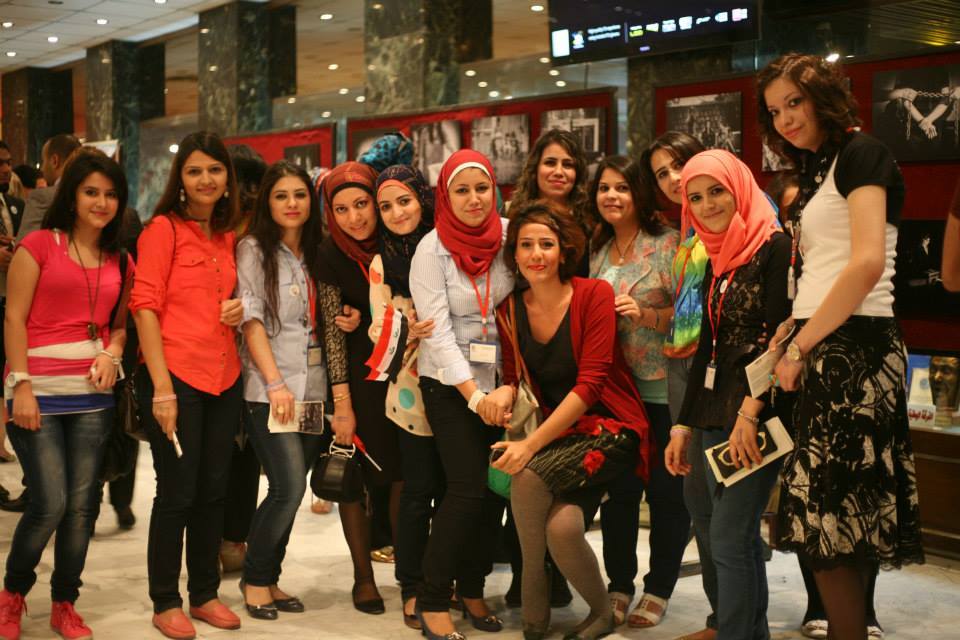
Rights without words

Participants in “Rights Without Words”

Photos: Copyright Dina Najem

“If someone asks you about what is happening in Syria tell him the humanity is died”

Today media has been flooded with the news that Syria has used chemical weapons in another one of their massacres of the citizens in Damascus suburbs, Eastern Ghouta. Some say victims counts in hundreds, others claim it’s over one thousand. Children suffocated to death after the and hospitals did not have enough resources to treat the overwhelming amount of victims rushed to the emergency rooms, where many more lives were lost, because what hospital can be prepared for a massacre?

I’m not posting the photos here but you can imagine what victims that has suffocated to death look like: frozen faces where panic and fear is still visible, mouth and eyes wide open.

It’s not the first time Syria has used chemical weapons on it’s citizens though. In March and April this year the Syrian government was accused of using chemical weapons in order to strike out the population. And in the 1980s the regime used the same kind of weapons to – effectively – crack down on the erstwhole uprising.

Today many of my friends Facebookpages were filled with sad and angry updates, and not of the regular kind. On one friends status, someone commented: “If someone asks you about what is happening in Syria tell him the humanity is died”

I Survived the Banyas Massacre (warning: gruesome story)

Who told me this story? It doesn’t matter. When did I here this? In June this year, one month after the Banyas massacre had taken place on May 3 2013, conducted by governmental troops on civilians. In Damascus noone mentioned the massacre by name, instead we called it “unrest” or “outbreak of violence”. The result of the systematic killing of everyone in the village is easily found online, but in the heart of the government controlled capital that is nothing you can talk about.

Why did the person tell me this story, despite the danger of talking about the ongoing crimes against humanity in Syria? I guess some things are just too unbearable to keep to yourself. I couldn’t share this story while I was still in Syria, but I can now. And why am I sharing it? I want the world to know. I hope all of you readers do, too.

“Do you know what happened in Banyas? They did something horrible there. They did something that no God allows, no religion allows. What they did is forbidden in all religions!What does the persons want, who are controlling our country? What do they want from God?

There was a couple here some weeks ago. They left me their number, look, here’s the note… When I heard about what happened in Banyas I tried to call them, I was worried. But the line was shut down, I didn’t even get a signal. I heard that they had shut down the lines to all the telephones in Banyas. I called and called.

First after a couple of days the man answered. He said:

They came in the night, they killed my wife and my two children‘.

His wife was pregnant when she was here, I saw it myself, she was seven or eight months pregnant. Do you know what they did to her? They cut her in the chest, like this. Then they cut open her stomach, her whole stomach, and took out the baby. Her husband cried when he said:

They killed her, they killed my unborn baby, they killed our two little children. I’m the only one left. They are all gone.

Whatever You Do, Don’t Get Raped in Dubai

In the Gulf and especially Dubai, prostitution is available everywhere. Online, at clubs and bars, in private parties. Young girls locked up or seemingly free; Asian, African, Eastern European. My experience is that prostitution is so common and accepted it’s hardly attached to any stigma for the buyers (“Why should I visit a whore?” a man once told me. “I get lots of women, I don’t have to pay!”). For being an Islamic country, this exception seems to exist within any moral remorses with the leadership.

So what’s the deal if you are forced to have sex against your will, if you get raped? The same legal system that overlooks the brutal sex trafficking will most likely confine you for having sex outside the institution of marriage and punish you as the victim instead. This goes for men and women, underage as well as adults.

This week the news broke that the Norwegian woman in Dubai, Marte Deborah Dalelv, who had been accused of premarital sex after reporting a rape to the authorities, was being “pardoned” and did not have to do her previously sentenced punishment in jail. Throughout the process she had been hiding in a Norwegian church in Dubai and international media had monitored the case over the past year. Now would a woman who was not white, westerner and with huge international support have been “pardoned” from the sentence? Probably not. And what else is, Marte’s rapist was pardoned at the same time.

Now many other countries have increased their legal support for victims of violence and sexual violence; in 2011 Iraqi Kurdistan passed a law that forbade domestic violence and in for example Lebanon there is a big network of women’s shelters with legal and social support for victims. Despite their financial lead, Dubai is still many years behind.

Campaign for Domestic Worker’s Rights in Kuwait

Human Rights Watch has launched Campaign for Domestic Worker’s Rights. The campaign is illustrated with photos of Arab women dressed in the costumes that many of the workers have to wear when on duty – which often is 15 hours per day, 7 days a week. Hopefully this will make people think.

I have repeatedly become surprised over how people’s brains stop working when exposed to something abnormal being normal – Arabs, Europeans, Americans alike – which is what the trafficking situation of poor people from Asia and Africa to the Middle East is today. I won’t dig into the subject of why you can’t clean your own house or raise your own kids, but on how today’s knowledge about human rights for some people seem to have vanished.

When living in Kuwait I had a friend from Eastern Europe who had married an Arab man residing in the country. She was a great girlfriend; caring, funny and smart, and I missed her a lot when moving. Going back to visit a few years later, she and her husband had got their first child and employed a live-in-maid, and suddenly I saw a new side of her. The woman they had employed, let’s call her Maria, was not allowed to call my friend and her husband by their first names, instead ”sir” and “maam”.

“If you let them call you by your name they will disrespect you, you can’t give them too much freedom,” my friend explained.

All house chores had been given to Maria who worked from 6 am to 10 pm without a break. She was not allowed go out on her own or make her own decisions about what to do during the day, had to follow my friend wherever she went, walking a few steps behind with all the bags and the trolley that she pushed the toddler in, when my friend was out with her girlfriends on one of their many shopping tours to the mall.

My friend thought she was nice to Maria. She could eat how much she wanted and slept in a bed in the child’s playroom – “Not on the floor like with the Kuwaiti families”. My friend didn’t seem to reflect on how Maria might feel when my friend called her stupid or criticized her for not doing anything right (I noticed this among many, the constantly criticizing of the domestic staff, as if they get a kick out of putting them down).

Now I happened to like Maria as a person and we spent some time talking. It turned out she had a university degree in her Asian home country and previously had a qualified job that she had lost, why her last way out if keeping her own child in a private school was to go abroad as a domestic worker. The experience had been a shock and she found herself not able to return as she had signed a two year contract and had her passport taken away. I suggested I ask my other friends about jobs in her field of experience and we secretly exchanged numbers. My research didn’t lead to anything but we kept in touch after I left. She often called and texted, feeling so alone and exposed.

Then a few weeks later my friend’s husband emailed me. My friend had taken Maria’s mobile to check on her and had read my messages. She and her husband were furious I had kept in touch with Maria and urged her to get a better job. This is an excerpt from the e-mail:

I would really like to thank you for treating your friends who were soo good, honest, loveable to you and accepted you in their home not as a guest but as a very close person. We are very surprised of the way you cheated us and tried to contact our nanny from our back and tried to help her to leave us and finding a job because you persuaded her that she’s over qualified to be a nanny…  If you think that you are supporting women right by encourage her to do what she did and leave us then let me tell you that you destroyed our lovely family and destroyed her life as well.

He ended the e-mail by telling story I had heard before, on how Maria had felt so empowered by me that she had brought home a man and had sex with him in a room next to where the child had been sleeping. The story is one version of many used to justify what happens if you give your maids “too many rights”; Asians are not only unintelligent, they are also sexually primitive if you fail to control them. Do you know your history? African–Americans were once considered the same way by whites.

My friend blocked me on all social websites we had been in touch through and we never spoke again. I don’t know what happened to Maria – the control must have increased and I assumed it was safer for her not to be in touch with me as I anyways was far away from Kuwait and had no means of helping her.

Human Rights Watch’s campaign is much needed in a time when again human rights doesn’t apply to people of color, and I wish it leads to some sort of change. If I could speak to my friend I would explain to her why I had urged Maria to leave and that I hadn’t mean to hurt my friend – but I wouldn’t say I’m sorry. And if I were in the same situation I would do what I did again, even if it meant losing a close friend. I know some people would say I’m fanatic. I say I’m normal.

Photocredit: Human Rights Watch

Turkish Police Brutality Silenced Online

Protesters in IstanbulJenny, please write about this in your blog! The government is doing terrible things to the people and our media is just playing mute and deaf

A Turkish friend e-mailed me today. She’s a regular Turkish young woman, uninterested in politics, who never showed any interest in activism or talking politics with me before. Attached was a link, where it said Turkish police had gassed the protesters with teargas, gassed the subway in Istanbul and an emergency room where patients of the attack had been treated. The link is now removed, as are blogs I’m trying to access- it seems the media is really being silenced from somewhere higher up.

A number of protesters had gathered in Taksim, the beautiful heart of Istanbul where protesters usually gather, to act against that the Gezi Park was to be taken down in order to give place to something else. Having known political activists in Turkey I know how the police and military usually used hard core methods when cracking down on activists – but this brutality is something new to me. Probably also to my friend, a patriot at heart, who never complained about her country before.

I will not publish the most horrific photos here as I want to keep the blog free from such pictures (you can easily find such pictures online anyway), but I’m asking you to share my blog post and these news. Turkey is a popular tourist resort that is trying to enter EU. The never ending brutality towards minorities and the population that are protesting in a peaceful, democratic way can only come to an end if the international community starts to be aware and put pressure on the current government. If Turkish bloggers can’t share the news, let us who are outside do it.