Hawzhin The Middle Eastern Feminist

Hawzhin Azeez

The Middle Eastern Feminist page singled itself out from other feminist pages on Facebook when it started up in December last year. Feminism across boundaries of ethnicity and nations; love over hate; support over anger, seemed to be the red threads for the page.

If you are struggling today, remember that you were never meant to be ashamed, depressed and guilty. You were always meant to be victorious! Don’t let the bastards grind you down,” says a quote followed by a heart from July 16.

The reconciling approach seemed to appeal to many. The page soon had many followers.

Often white, middle class women are blamed for having this approach to women’s rights as they haven’t faced real hardships themselves. But the woman behind The Middle Eastern Feminist page is not one of those.

Hawzhin Azeez’s early childhood memories consists of escaping Iraqi Kurdistan as Saddam Hussein bombed the area with chemical weapons; her pressing a scarf against her face not to breath in the lethal smoke; her mother having skin burns all over her. Living as illegal refugees in Iran the family sometimes didn’t eat for days, and on a regular basis the police came and took away her father, accusing him of being a part of the resistance against the Iranian regime due to his Kurdish ethnicity. The family never knew when or if he was coming back. In this setting there was no room for women’s rights.

“When growing up in a refugee setting, in war-torn countries, it’s incredibly hard being a woman,” says Hawzhin when explaining her upbringing and how she became a feminist. “People hold on to their ethnicity and as a young woman you’re just supposed to behave.”

After finally receiving asylum in Australia, Hawzhin and her family faced a new dilemma: the one of suddenly being in a liberal culture with new gender roles that they had no idea how to manage.

“I was going through my puberty in a family traumatized from the war,” Hawzhin says. “And we were stripped off our identity. My parents were very traditional and conservative and it was difficult for me to be friends with Australian girls. It was an isolating experience going to a Western school.”

In the Kurdish community where they lived a strong social control was being exercised. Hawzhin points out that it was first and foremost the women who exercised this control over each other and each other’s daughters. She says they had internalized the racism and sexism they had been exposed to as Kurds in the Middle East, and turned it into misogyny.

“Gossip was used a tool to limit and control each other between women. It was used to shame and guilt what women and girls did in the community.”

Despite the lack of role models, Hawzhin knew she was a feminist.

“I was born a feminist!” she says. “In Iran I witnessed things that were incredibly wrong and unjust. Religion was used as an ideology to limit the women, what they wanted to achieve. What chador means for me as a human being is that I become sexualized.”

As a teenager she was incredibly angry because she wasn’t able to live her life the way she wanted to. She read a lot of feminist literature in high school, it was her escape.

“My choices were directly linked to my family, if they agreed. I couldn’t create any issues for my family in the Kurdish community. It was a constant struggle between the community’s values and my feminism.”

Despite having arrived to Australia as an 11 year old with only two years of primary school education, Hawzhin was able to enter university after high school to study international relations and political science. But even having made it so far, she couldn’t live the way she wanted to. When she moved out of her parents’ house to do her PhD in another city at 25 years old, she was finally able to be independent. But it took a long time for her to adjust.

“I had no idea who I was. Growing up in a patriarchal family I had been constantly told how to behave and how to live. I now choose to live independently and I wish for every girl to have this freedom. Unless you do this you will never be able to make informed decisions on yourself.”

When starting The Middle Eastern feminist page it was after a long and difficult semester at university, when she was emotionally drained and spent a lot of time in front of Facebook. She noticed how people mostly posted things about what they ate and going to the gym, and wanted to turn her Facebook time into something more intellectual. Her motivation also steamed from being back in her country of origin for the first time since the escape. She went on her own without her parents and met up with her relatives. The trips were wonderful, she says, but she noticed how little women in Iraqi Kurdistan knew about their rights, and this was something she wanted to change.

“I wanted a safe place for Middle Eastern women or women from developing societies where they could talk about their rights and issues they were dealing with. But I also wanted to challenge them and tell them they could have a traditional life and still be feminists.”

Hawzhin mean that some women in the Middle East might not be able to escape their traditional life but that they can find space where they can still be feminists.

Another goal was to educate Western women on Middle Eastern women’s issues. She wanted a place for women from the two worlds to meet and realize that they were dealing with the same issues.

“Women everywhere are dealing with for example street harassment. Although the issues Middle Eastern women have are on another level, we are all struggling. I wanted to create a place for solidarity, for women to find commonalities in their lives.”

“Have you felt supported by Australian feminists or have you felt excluded?”

“Feminism in Australia is not a priority for many people… There is also a barrier between privileged women and women of color. A lot of the feminist groups and women are diffused within the political movements, there are not many groups trying to bridge the gap between privileged women and women of color, to bring all of these different identities together. But this is necessary.”

The page is now an active place for discussions and many of the over 6.000 followers are not only from the Middle East but from all over the world. Through the page connections are being made and people are making friends across boundaries. Hawzhin is actively promoting other feminist pages on her own, urging her followers to like a new page that has recently been started. She’s also sharing her private Facebook page with followers that want to add her as a friend – a page where she has posted photos of herself and her mom hugging, dressed up in Kurdish clothes, as well as photos from university parties where she’s dolled up (“I dress very femininely, I love to wear lipstick,” she says on a side note).

On combining the different cultures, she says that she sees herself as a bridge between women in Afghanistan who can’t leave the house, and urban, developed women in Egypt; that they can contribute to each other through the page.

A long message to her followers on the page from July starts like this:

I haven’t said this in a while, but: I am so incredibly in love with all you inspiring feminists (male and female), and the new ones on this page and the ones that send me private emails and share their stories, and those of you who comment and make witty and brilliant comments to posts. I know that we all come from different cultural and social settings but that does not take away from the fact that we are all struggling against a global system which thrives on the oppression and subjugation of people based on their gender or sexual orientation or race. All of our struggles matter, though the problems we face may differ somewhat.

Hawzhin has had very little negative feedback on her page and says she is shocked by the amount of support and number of women that have been contacting her. Some people expect that she’s a Muslim feminist but this is not what she calls herself.

“I call myself a secular feminist,” she says. “But if women want to cover up that’s great – I don’t believe in ripping women off their scarf.”

“Does your family know you’re a feminist?”

She laughs:

“Oh yes, very much so.”

So how are her parents, the once traumatized refugees that had such a hard time to adjust to the new society they were in, dealing with their daughter having developed to being such an outspoken feminist?

“My family has come such a long way,” she says, delighted. “There were so many things we couldn’t discuss before due to our culture, but this has changed. I am now teaching my younger sister and brother about feminism. When I visit them I always show them feminist documentaries, and my sister who is 13 comes with me to political marches. I’m teaching her to be more independent. It’s important to start with the children.”

Photo 1: Copyright Hawzhin Azeez, Photo 2: Copyright Sweden and the Middle East Views Blog

Kurdish Mobilization for the Murdered Girl

20140529-221926-80366305.jpg

Dunya

A few days ago the horrifying news about a young girl who was the victim of a honourkilling in Dohuk in Northern Kurdistan spread over the world. Dunya, a 15-year-old girl who was in an arranged marriage with a 45-year-old man, according to kurdishrights.org his name was Sleman Ziad Younis, had been killed by him and the photos of her mutilated body filled the internet.

These news are unfortunately not rare in Kurdistan. Violence against women is a wide spread phenomenon – I dare saying this as I have worked with women’s rights issues in the region – and many of these crimes are swept under the rug and forgotten. Only in 2011 domestic violence became illegal in Kurdistan and even though this legal change marked a great step forward, the process of actually implementing the law and change attitudes is very long, as always when a society is in a process of change and is developing from a troubled past. Unfortunately the change was not quick enough for Dunya.

But in the aftermath of the petrifying news something happened. Women’s rights groups – there’s quite a few of them, consisting of both men and women – started to call for a mobilization against what had happened. I actually first found out about this story when one of my male Facebookfriends who is a human rights activist changed his profile picture to the picture of a young Dunya. Progessive Kurdish media condemned the causes of the murder, not only the act itself; Dunya’s parents selling off their little girl to an old man, the society not taking actions against it. Events were being set up to demonstrate against  violence against women and in support of the girls as Dunya. Yesterday May 29 the first event was held, a demonstration outside the Kurdistan parliament in Erbil called “Stand up for Dunya”.

I asked my Kurdish friend Camaran who went how he thought the event was, and he answered:

Today I went to the civil protest that took place in front of the Parliament, and continued for an hour in which the civil servants and human right activists spoke about the ordeals that women experience in their daily life in Kurdistan. 

Dunya has become the symbol of such brutality. A 15 years old child!

But I was generally disappointed at the number of participants… out of 2000 something people that responded to the event on Facebook, only around 150 people showed up.

But even though Camaran was disappointed fewer people than expected showed up, the event marked an important change. Also the fact that he as a man was there and participated in the struggle, just like my other male friend who made Dunya’s photo his Facebook profile picture. Some years ago a similar sight would have been impossible.

Photo credit: nrttv. com

Diving Sisters from Saudi Arabia

saudi gazette

Noor Al-Dubais (left) and Taammul Al-Dubais (right)

Photo credit: saudigazette.com.sa

Two sisters from Sanabis town on Tarout Island on the Eastern coast of Saudi Arabia made headlines this week as some of the few professional women divers in the country.

The local newspaper Saudi Gazette reports that Noor and Taammul Al-Dubais were raised in a seafaring family and that they have been surrounded by water all their lives. Noor was 5 when her father taught her how to breath under water and the sisters held their international diving licenses as 10 year olds. Now they wish to pass on their passion for diving to other girls. They are diving as a professional duo and have been diving on many different occasions.

They started to dive in the city of Jubail on the east coast, around Jana Island. Noor says to the newspaper Alsharq daily, regarding her diving experiences in the Red Sea off the coast of Jeddah:

I swam among the beautiful coral reefs as if I was a bird flying in a garden. I enjoy diving because my soul separates from my body when I am at great depths.

She says she finds guidance in her parents and that her friends from school encouraged her. The sisters’ father has been a great supporter and he himself is also a diver and a fisherman. He is also Noor’s and Taammul’s professional trainer and has designed a special diving suit for women that he said respects Saudi customs and traditions. Sports for Saudi women are not accepted by everyone and professional sports women in the Kingdom are an exception. But the sisters’ father says:

Noor and Taammul are part of a diving family that loves to look for coral reefs and explore the magical waters of the Gulf. All of my sons and daughters are divers.

Hopefully Noor and Taammul will set an example for many other brave young women around the world.

Women Owned Restaurant in Saudi Arabia Breaking New Ground

Hi Jenny – this Saudi woman could be interesting for you to write about her” my half-Kuwaiti half-Saudi friend started her email to me the other day.

In the coastal city of Dammam, Saudi Arabia, an occurence has taken place that hasn’t yet reached English international news. The Saudi woman Nora Almoqateeb was able to open a new restaurant-concept in her own name, kitchen-run by all female, despite public pressure not to. When Nora came up with the concept for the restaurant Nooryat, the first official employee receiving the application refused to give her the license to open restaurant. As Nora describes in the video (unfortunately available in Arabic only):

“He threw the file in the drawer and said ‘Are you crazy? You want to mess up the country and the women? It’s forbidden!'”

But she didn’t give up instead went to research in the local laws. She didn’t find any single Saudi law preventing her and in the end she managed to get the license, then employed Saudi women to work with her in the kitchen. She says:

“I felt I was gunpowder wanting to explode. It exploded! I was determined to get the license.”

When Nora opened the restaurant Nooryat she was afraid to go there alone. The restaurant was watched all the time by people who want to try and find small mistakes so that the restaurant could be closed down. Nora’s female worker are all Saudi, and despite being proud of their job some of them are ashamed to admit that they are working as cooks, and are afraid to give their full name. But despite the resistance Nora didn’t cave in and the staff says that they admire Nora and consider her a great female idol for all Saudi women. Nora has been so determined to carry out her business that she sometimes sleeps in the restaurant when she has a big order to deliver. In fact the word Nooryat is associated to the Arabic word for light, such as the light that lights up a house.

Along the way she had big support from her own father, and the owner of the building where to restaurant resides says:

“The main problem is that men don’t except the idea that a woman leaves her home, work in a commercial building, and cook for people”.

Now the restaurant has been nominated to the local Israr Award for 2014 – “Israr” meaning “Determination”. Let’s keep our fingers crossed she will win.

First Saudi Policewoman Ever to Graduate!

ayat bakhreeba

Yesterday the world suddenly became a little better place to live – a Saudi woman graduated from the Dubai police academy, and according to the news she is the first Saudi woman ever to become a police officer!

Leaving few traces of herself online and unknown to international media before her graduation, Ayat Bakhreeba did not only become the first Saudi police officer ever. According to Riyadhconnect.com and other Gulf media, Ayat Bakhreeba is graduating in public law with a thesis research on children’s rights in the Saudi regime – a brave subject in a totalitarian regime. For a country that systematically discriminates women and children, this woman is taking a small step on the moon; which is a big step for humanity. Not that I’m surprised with the Saudi women, not at all. Things are shaking up in the kingdom.

Photo credit: Emirates247.com

Dina – Women’s Rights Activist in Iraq

fist gallary(1)

Dina Najem became an activist after finishing her degree in French at the university in Baghdad, when she started blogging and became active in social media and realized how invisible the women were in Iraqi media.

“Iraq has always been a closed society,” she says. “Even before the US invasion the society was controlling towards women, and after 2003 there was no security at all. Women couldn’t even walk outside alone.”

Dina, now 24, decided she wanted to work for women to be able to participate more in the society.

“I have myself no support from the society” she says. “It’s my husband and my family that supports me. The government has the ability to improve the lives for Iraq’s women, they have the financial resources, but they are not doing anything.”

After a few years as an activist within local NGOs and social media Dina applied in 2012 to the Swedish Institute’s academic program for human rights activists from the Middle East and North Africa, “Social Innovation in a digital context”. She was accepted as one of 15 participants, and so was her husband Hayder, who is also an activist.

“I wanted to focus on women” she says. “Men are already dominating trainings, the political life, everything.”

She believes many women have not been fighting for their own rights.

“The war made so many stay at home, they were prevented from educating themselves. Women don´t have the knowledge to demand their rights.The one that does are not a big number.”

Lack of technical skills is another reason for the absence of women in Iraqi media according to Dina.This makes them unable to compete with men who are in the same business. With the knowledge gained on digital media from the Swedish Institutes program Dina was able to start training others.

After the six months long course she returned in April this year to Baghdad and started the photography project “Rights Without Words” for young women in the ages of 20 to 30. She went herself to look for a sponsor and got International Media Support to fund the project. By publishing information about the course online she received an overwhelming number of applications. There are obviously many young Iraqi women that want to make their spot on the media scene.

Finally Dina chose to include 22 participants instead of 15 as originally planned. The training was divided into three courses: human rights, photography and social media.

“I want to promote human rights in a creative way in my project. The participants have learned how to express themselves by photography, and how to illustrate the declaration of human rights without using any words.”

Dina has already been able to show the photos in the Iraq National Theatre, when the Iraqi musician Nasser Shamma was hosting a concert, a previously rare but nowadays more frequent happening in the capital.

Dina hopes that the world is interested of the positive development that is taking place in Iraq. She and her husband are not planning to move abroad – they want to continue with their activism despite the insecurity in Iraq. Even though she criticizes the domestic politics she thinks that there is hope in the expanding civil society. The many applicants to her project are a sign of willingness to change.

“I’m hopeful” she says. “I see so many girls that want to study and participate in everything.”

Next up in her work is to focus on women bloggers, and she also wants to work with mixed groups of young women and men. In a country where the sexes often are separated she thinks it’s crucial for women and men to work together and get to know each other.

The struggle for women’s rights is the core of her activism and she openly calls herself a feminist despite the resistance she often encounters. At the same time she is a Muslim and proud of that.

To the ones who question Dina’s commitment to human rights in a country where civilians are killed every day, she usually says:

“Well, but you can’t just sit on your chair. You have to defend your own rights.”

Rights without words

Participants in “Rights Without Words”

Photos: Copyright Dina Najem

Saudi Women – Gender Apartheid: 1-0

General court in RiyadhFinally a change that’s not an April fool’s joke!

Today on October 6 Saudi Arabia’s Ministry of Justice is supposed to issue licenses for four female lawyers, that would make them eligible to work as lawyers in the country. Previously, Saudi women have only been able to work as legal consultants, meaning they could not open law firms or represent clients in court. With the change in practice, not only could the Saudi female lawyers now practice the profession they spent years educating themselves to exercise, it would also mean that women who are trials now have the right to have a woman representing them for the first time ever. Women who are meeting their ex-husbands in court over custody battles and in the very few cases of domestic violence brought to court, women often found themselves being the losing one, no matter how strong her case was. With professional women in the legal system women will at least have a voice in the court room.

On social websites the news was flooded with comments from all sides. Not everyone was positive to the potential impact it will have on the society. “Baby steps” a comment on the link that the Facebooksite Saudi Women to Drive shared with the news; “Where will they work?” asked another. It’s impossible for me not to agree on the criticism, but baby steps with Western standards for gender equality is in Saudi Arabia a game where Saudi Women today scored 1-0 against the gender apartheid system.

I’d prefer to say: What’s next?

Photo credit: rt.com/AFP Photo

Whatever You Do, Don’t Get Raped in Dubai

In the Gulf and especially Dubai, prostitution is available everywhere. Online, at clubs and bars, in private parties. Young girls locked up or seemingly free; Asian, African, Eastern European. My experience is that prostitution is so common and accepted it’s hardly attached to any stigma for the buyers (“Why should I visit a whore?” a man once told me. “I get lots of women, I don’t have to pay!”). For being an Islamic country, this exception seems to exist within any moral remorses with the leadership.

So what’s the deal if you are forced to have sex against your will, if you get raped? The same legal system that overlooks the brutal sex trafficking will most likely confine you for having sex outside the institution of marriage and punish you as the victim instead. This goes for men and women, underage as well as adults.

This week the news broke that the Norwegian woman in Dubai, Marte Deborah Dalelv, who had been accused of premarital sex after reporting a rape to the authorities, was being “pardoned” and did not have to do her previously sentenced punishment in jail. Throughout the process she had been hiding in a Norwegian church in Dubai and international media had monitored the case over the past year. Now would a woman who was not white, westerner and with huge international support have been “pardoned” from the sentence? Probably not. And what else is, Marte’s rapist was pardoned at the same time.

Now many other countries have increased their legal support for victims of violence and sexual violence; in 2011 Iraqi Kurdistan passed a law that forbade domestic violence and in for example Lebanon there is a big network of women’s shelters with legal and social support for victims. Despite their financial lead, Dubai is still many years behind.

Campaign for Domestic Worker’s Rights in Kuwait

Human Rights Watch has launched Campaign for Domestic Worker’s Rights. The campaign is illustrated with photos of Arab women dressed in the costumes that many of the workers have to wear when on duty – which often is 15 hours per day, 7 days a week. Hopefully this will make people think.

I have repeatedly become surprised over how people’s brains stop working when exposed to something abnormal being normal – Arabs, Europeans, Americans alike – which is what the trafficking situation of poor people from Asia and Africa to the Middle East is today. I won’t dig into the subject of why you can’t clean your own house or raise your own kids, but on how today’s knowledge about human rights for some people seem to have vanished.

When living in Kuwait I had a friend from Eastern Europe who had married an Arab man residing in the country. She was a great girlfriend; caring, funny and smart, and I missed her a lot when moving. Going back to visit a few years later, she and her husband had got their first child and employed a live-in-maid, and suddenly I saw a new side of her. The woman they had employed, let’s call her Maria, was not allowed to call my friend and her husband by their first names, instead ”sir” and “maam”.

“If you let them call you by your name they will disrespect you, you can’t give them too much freedom,” my friend explained.

All house chores had been given to Maria who worked from 6 am to 10 pm without a break. She was not allowed go out on her own or make her own decisions about what to do during the day, had to follow my friend wherever she went, walking a few steps behind with all the bags and the trolley that she pushed the toddler in, when my friend was out with her girlfriends on one of their many shopping tours to the mall.

My friend thought she was nice to Maria. She could eat how much she wanted and slept in a bed in the child’s playroom – “Not on the floor like with the Kuwaiti families”. My friend didn’t seem to reflect on how Maria might feel when my friend called her stupid or criticized her for not doing anything right (I noticed this among many, the constantly criticizing of the domestic staff, as if they get a kick out of putting them down).

Now I happened to like Maria as a person and we spent some time talking. It turned out she had a university degree in her Asian home country and previously had a qualified job that she had lost, why her last way out if keeping her own child in a private school was to go abroad as a domestic worker. The experience had been a shock and she found herself not able to return as she had signed a two year contract and had her passport taken away. I suggested I ask my other friends about jobs in her field of experience and we secretly exchanged numbers. My research didn’t lead to anything but we kept in touch after I left. She often called and texted, feeling so alone and exposed.

Then a few weeks later my friend’s husband emailed me. My friend had taken Maria’s mobile to check on her and had read my messages. She and her husband were furious I had kept in touch with Maria and urged her to get a better job. This is an excerpt from the e-mail:

I would really like to thank you for treating your friends who were soo good, honest, loveable to you and accepted you in their home not as a guest but as a very close person. We are very surprised of the way you cheated us and tried to contact our nanny from our back and tried to help her to leave us and finding a job because you persuaded her that she’s over qualified to be a nanny…  If you think that you are supporting women right by encourage her to do what she did and leave us then let me tell you that you destroyed our lovely family and destroyed her life as well.

He ended the e-mail by telling story I had heard before, on how Maria had felt so empowered by me that she had brought home a man and had sex with him in a room next to where the child had been sleeping. The story is one version of many used to justify what happens if you give your maids “too many rights”; Asians are not only unintelligent, they are also sexually primitive if you fail to control them. Do you know your history? African–Americans were once considered the same way by whites.

My friend blocked me on all social websites we had been in touch through and we never spoke again. I don’t know what happened to Maria – the control must have increased and I assumed it was safer for her not to be in touch with me as I anyways was far away from Kuwait and had no means of helping her.

Human Rights Watch’s campaign is much needed in a time when again human rights doesn’t apply to people of color, and I wish it leads to some sort of change. If I could speak to my friend I would explain to her why I had urged Maria to leave and that I hadn’t mean to hurt my friend – but I wouldn’t say I’m sorry. And if I were in the same situation I would do what I did again, even if it meant losing a close friend. I know some people would say I’m fanatic. I say I’m normal.

Photocredit: Human Rights Watch

Xena the True Lebanese Feminist

Xena Amro

This article is published in an edited, Swedish version in the feminist magazine AstraNova’s October issue 2013.

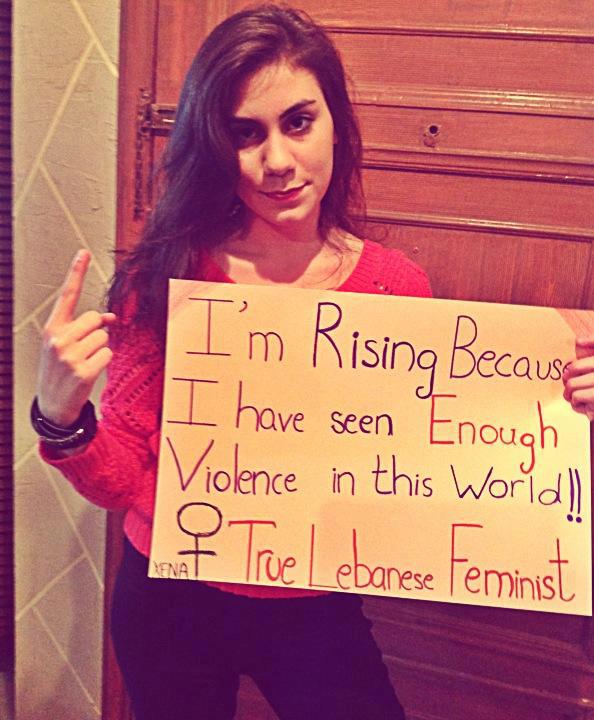
When Xena Amro started the True Lebanese Feminist Facebook page in July 2012, it created turmoil. Xena’s own Facebook page had been reported and blocked several times, so she wasn’t surprised.  On her desk in high school, random insults were written in the beginning of her school year: “Xena is stupid”,Lesbian”, “Feminism sucks ass”, reads the messages that she shows to me when we meet at Starbucks in Beirut, pictured on her smartphone.

Why was it so provoking to her fellow students that Xena was an outspoken feminist? Was it because of the success of her page? Or was it because of her uncompromising position? “I am a feminist, because those ignorant rapists out there, have limited my Freedom! They have ruined my childhood! And made me lose my mental innocence!” says one post from September 2012.

Despite the harassments in school and on the Facebook page, Xena kept up her page and now it has over 6.000 followers. She has support from both men and women, and she says she loves it especially when men become feminists:

“That’s what’s keeping me strong” she says.

Xena became a feminist early in 2012 when she was one of the winners in a competition for young writers, on the topic “In Lebanon”. “True Lebanese Feminist” was the story’s name and it was chosen to be in the top 12 list nominated for the prize. After the story and the competition, it was impossible to look back.

Xena explains on how stories about domestic violence reached her and that the general suppression against women was what made her become aware at such a young age.

“The purpose of the page is to raise awareness about women’s issues not just in Lebanon, but also globally” she says. “There are too many stereotypes placed on women that I want to fight against.”

I started to follow the page myself in the beginning and have seen it explode in to what must have been a previous vacuum, where a similar feminist page didn’t exist before. On Facebook there are many pages for women’s rights, but few that create as much discussions. What makes the page different is also that when someone attacks Xena or her statements she often don’t reply, but let the discussion have its course, relying on her supporters on the page, and makes a point out of not insulting anyone back.

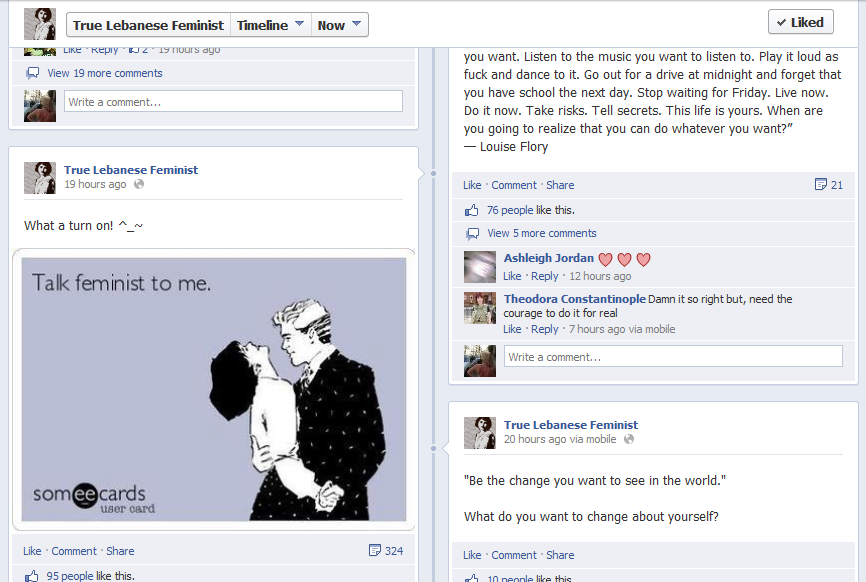
Every day the self-taught 17-year-old Xena updates the page with pictures combined with quotes; invites the followers to discussions; and shares other women’s stories. Female Arab writers like Joumana Haddad and Nawal El Saadawi inspired her. The numbers of followers quickly increased and the page turned into a place full of heated discussions. Not shying away from any subject, Xena brings up religion, sexuality and mass media from a feminist point of view:

Today is the international day for safe abortion!” reads a post with a link to “Women’s Rights to Abortion in Lebanon

True?” over a photo that states “Girls see over 400 advertisements per day telling them how they should look”.

Calling myself an outspoken dictator wouldn’t get me as much hate as I’m getting for calling myself an outspoken feminist” says another one.

Despite being as provocative in a society as Lebanon, one of Xena’s goals is to increase the number of Lebanese people on her page – out of 6,000 followers only 528 are from Lebanon (in comparison with 1,532 from US). It might not be a coincidence since her posts on religion and its links to patriarchy provokes many, and she has been accused of being a westernized atheist that hates religious people – a quite harsh insult in a society where religion plays a crucial role. Still Xena wants her page to stay relevant in her own country.

“I don’t hate religious people” she says. “They have the right to think whatever they want, and so do I – this is freedom.”

Since the beginning also emails for help has poured in. Many women from different countries have been writing to her about violence and rape, desperate for support, probably not knowing Xena is only 17. Xena takes her time to answer all emails, urging girls and women to seek help and not to feel ashamed.

I ask her how she handles it all. On top of managing the page on her own and the publicity it has given her, she gives feedback to all the members writing to her, and is also trying to finish high school to hopefully be admitted to nursing school this year. She admits that her parents, although very supportive of her feminist page, are worrying about the toll it might take on her grades.

“It takes all my free time… But the page is not pressure, it’s relief. I see a lot of injustice in the society, and I don’t want to hold these grudges in my heart.”

Photo credit: Xena Amro