

Photo: Copyright Sweden and the Middle East Blog

Photo: Copyright Sweden and the Middle East Blog
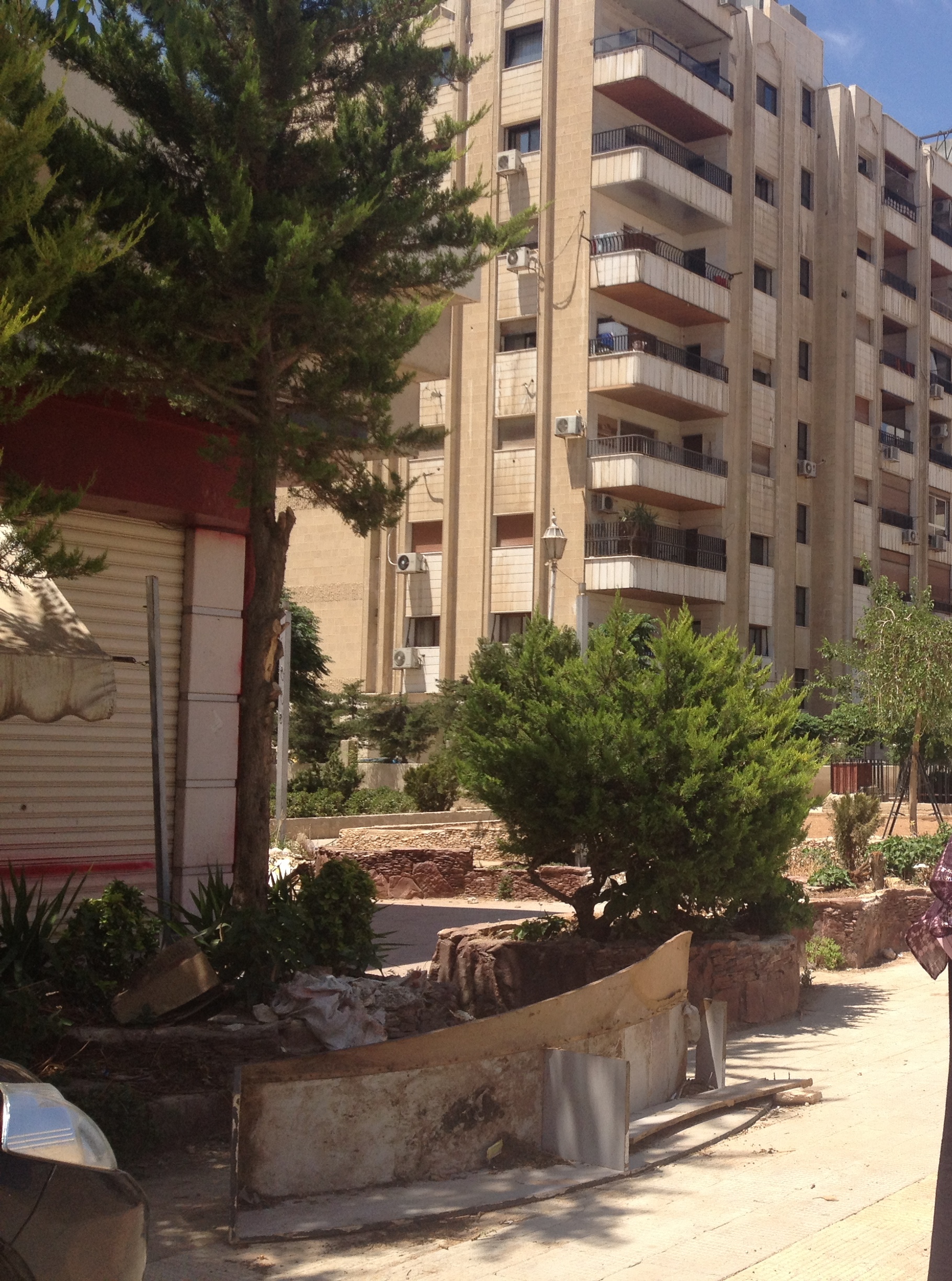
The other day I had spilled food on my hand when eating outside and needed to wash it. In a street corner a man sold candy and chewing gums from cardboard boxes. I had seen him before as I passed the corner every day, it was close to my work place in Damascus. In the morning I saw him coming and loading the boxes with the unsold items from the day before – overnight he covered the boxes and the wobbly tables the boxes were placed on with different pieces of fabric tucked together. The man was sitting on the side of the street, I approached him and asked for a “small bottle of water”.
“I don’t sell water.”
Of course, the little stall didn’t have a fridge, how could he sell any drinks? It had been a stupid question to ask.
“Aha, ok. Sorry.”
I turned to leave.
“But, wait…”
He remembered something, got up and went over to the tables, started rummaging around among the fabric. He picked up a box of clean paper cups and a big bottle of water, his own water, then poured me a cup. I fetched my wallet with my other not-so-greasy-hand and picked up some coins.
“Thank you, how much is it?”
“Nothing.”
Some weeks before I had been ripped off in a grocery store, paying twice as much as I should, and when I realized I couldn’t be particularly mad. Most people would rip anyone off if they were on the brink of poverty, especially a foreigner who had much more, in a time when the country’s currency was falling dramatically until the previously big-bills turned small-bills turned nothing. I wanted to pay and insisted, offering the coins. Suddenly the man looked sad. Just sad.
“I don’t want any money. Please take it, my daughter.”
That made me quiet. I mumbled a thank you. In that little moment, kindness won over war. It’s not a small power, not a sign of weakness. I believe it can sometimes be very strong.

Photos: copyright Sweden and the Middle East blog
 “Jenny, please write about this in your blog! The government is doing terrible things to the people and our media is just playing mute and deaf“
A Turkish friend e-mailed me today. She’s a regular Turkish young woman, uninterested in politics, who never showed any interest in activism or talking politics with me before. Attached was a link, where it said Turkish police had gassed the protesters with teargas, gassed the subway in Istanbul and an emergency room where patients of the attack had been treated. The link is now removed, as are blogs I’m trying to access- it seems the media is really being silenced from somewhere higher up.
A number of protesters had gathered in Taksim, the beautiful heart of Istanbul where protesters usually gather, to act against that the Gezi Park was to be taken down in order to give place to something else. Having known political activists in Turkey I know how the police and military usually used hard core methods when cracking down on activists – but this brutality is something new to me. Probably also to my friend, a patriot at heart, who never complained about her country before.
I will not publish the most horrific photos here as I want to keep the blog free from such pictures (you can easily find such pictures online anyway), but I’m asking you to share my blog post and these news. Turkey is a popular tourist resort that is trying to enter EU. The never ending brutality towards minorities and the population that are protesting in a peaceful, democratic way can only come to an end if the international community starts to be aware and put pressure on the current government. If Turkish bloggers can’t share the news, let us who are outside do it.
 “You want to go see my friends? They’re African, they speak good English” my neighbor in Amman asked me one Thursday afternoon years back. In the sleepy little area we lived there were not a big variety among the neighbors, so I became curious and tagged along.
Long before that, no one knew when, the father of Sameera and her sisters left his country Nigeria, supposedly to go to Mekka, travelling by land for several months until he came to Jordan. For some reason, if money went out or whatever it could have been, Sameera’s father decided to stay there for a while. Back then Amman was just a village and foreigners a rarity, so rare that the authorities quite soon offered him a passport. There were a few other Africans in Amman though, and someone pointed out the houses to him: “Here lives an African family!” And so he met Sameera’s mother whose father originated from the Ivory Coast, and for a while became a lifetime; he never saw Nigeria again.
Sameera was cool and smart, too broad in her mind for the suburb where she had lived all her life. Her father, illiterate himself, decided that his six daughters were going to be educated, and sent them to college. To his son and other people he said: “No one is going to tell my daughters anything”. Probably he was the one to blame for their independency that stayed present even after he and their mother had passed away. They all worked and made their own money, only one of them getting married, to a Kenyan man that she said respected her freedom. The others saying they didn’t want the burden of being controlled. Sameera and her sisters fully identified as Africans, sticking to African satellite channels and music, even though they had never been. Later on, with the UN moving in big-scale to Amman the city became more international, with foreign women dressing in tank tops and Starbucks popping up in street corners. But the international vibes of a city often has a way of not reaching the original citizens, the ones limited by the conservative ways of condemning those different African girls that lived by themselves, worked for themselves, dressed in modern clothes.
I always had a good time at Sameera’s place and I wanted her to come visit me in Beirut when I went to stay there the upcoming year. She was up for it after some persuading. Collecting her best outfits, she called me a number of times before she left; “Can I have white jeans in Beirut? That’s cool there?”, and took a shared taxi for the eight hours ride.
She cried the first evening on my balcony and I got perplexed: what was wrong? But it was just the free spirit of Lebanon and the mixture of people that she saw. She was no longer the odd one; she was just one among many. “I’m sad because of all the beautiful things I see, I see nothing of this is in Amman”, she said.
That weekend was the best, we had so much fun. It was Beirut in the summer in the mid-2000s: clubs were open until the morning, people could still afford going out, Tiesto and Amr Diab was the DJs choice for the night. Our exotic appearance, the blonde girl and the black, was priceless. We didn’t pay entrance anywhere, the Buddha Bar DJ invited us to party with his crew, not understanding why such an urban girl like Sameera didn’t drink or wanting to date, and Sameera acted like she was born in the cosmopolitan city, showing off her amazing dancing skills that she rarely got to practice, pretending she was American when someone asked (“Hey I ain’t gonna see them again!”). When we grew tired of the company we told them we were going home, then hopped into a cab and went to the next club.
We’re not in touch anymore why I don’t share her real name or photo. But I hope she would agree on me sharing her story, because being a minority is never easy and she was a person that showed someone can grow different from her society and still remain her integrity, becoming the special person that she was. Or as Sameera said once, to a taxi driver in Amman that criticized her for being a Muslim and not covering herself:
“Ammo, I am a Muslim and when I read the Qur’an and decide that I will cover, at that time I will cover. Until then I will mind my own business, and you mind yours.”
Photo credit: http://www.primetravels.com
 In the park outside our house in Damascus, Syria, new families regularly come to sleep for a couple nights before being escorted away. The few belongings they keep themselves with; blankets, clothes and plastic cups, are being hauled away at the same time. Where do they go? To the temporary camps in schools or mosques? Will they be one of the families living in unfinished buildings, without electricity or water, with no protection from strangers?
One afternoon when I was meeting up with a friend, a teenage girl saw us walking on the street. She came up, asking for money.
”No, habibti.”
After a couple of weeks here I have improved my skills in saying no. And if I gave to someone living close to me, I might be harassed every day.
“Ahmed!” the girl called out and a little boy, maybe 5 years old, ran between us. He didn’t look like the kids I usually saw sleeping in the parks, he was different: even though being barefoot he easily crossed the pebbly street, and no adults were to be seen around. When being approached by kids in other cities, I sometimes ask: “Why are you on the street like this? Why are you not with your mom?” That usually makes them back off, feeling a bit ashamed of their parents sending them out to beg. But I had a feeling that wouldn’t take effect here.
“Please khala, we’re hungry.”
”No.”
The girl was dressed like an adult even though she recently must have entered her teens. Her long dress was ripped, her black scarf hung loosely around her head, displaying her hair, as if she didn’t care anymore.
“They have been in our house too, banging the doors, screaming for money,” my friend told me.
The little boy pulled my blouse, aggressively: “Please!”
I freed myself from his grip and turned around. We tried to speed up the pace to get away. After a few steps, stones and other small things started falling down on us.
“Khallas!” (Stop it!) I yelled to the one closest to me, it was the girl that had ran up behind us.
“No, I won’t stop!”
More stones came swirling through the air, the boy had catched up with my friend and suddenly struck her in the back.
“Hey!” she turned around and raised her hand, appearing a bit stronger than I had.
First then the kids slowed down, but they didn’t stop. It wasn’t until then that I realized they were not afraid of being hit. The girl already had traces of a black eye and scratches in her face. After a while the children seemed to lose the energy to harass us. They stopped, only throwing some small sticks at us as we left the park.
Later that day I saw them again, this time accompanied by two other children. The little group followed people on the street, pulled their clothes, pulled an old woman’s long robe. They received nothing from no one. In a state of conflict, no one is willing to give up whatever little they could spare. One of the boys was now being dragged along the sideway by an older girl, she half carried him. He was beyond tired; exhausted. Another boy, maybe 11 or 12, carried a long stick, violently swinging it back and forth. One man yelled at them, others got scared by the boy and his stick, and crossed the street.
I caught myself thinking, as if I wanted to tell them: “We can’t blame you, you’re just ordinary children. It’s not your fault that you had to become like this.”

Photo: Copyright Sweden and the Middle East Blog
A few years back, what did you associate Kurdistan with? If you had the same idea like me, an isolated war-torn place in the mountains might be what came to your mind.
In the few years after receiving it’s independency, Kurdistan has rised from it’s broken past and is now a developing region with a booming economy. Tourist resorts, 5 star hotels and fancy restaurants has taken the place of the refugee camps that we got so accustomed with on TV. If you’re in Erbil and looking for a night out, you can go to “Salsa Erbil” or any of the other Facebookpages dedicated to entertain young and bored people.
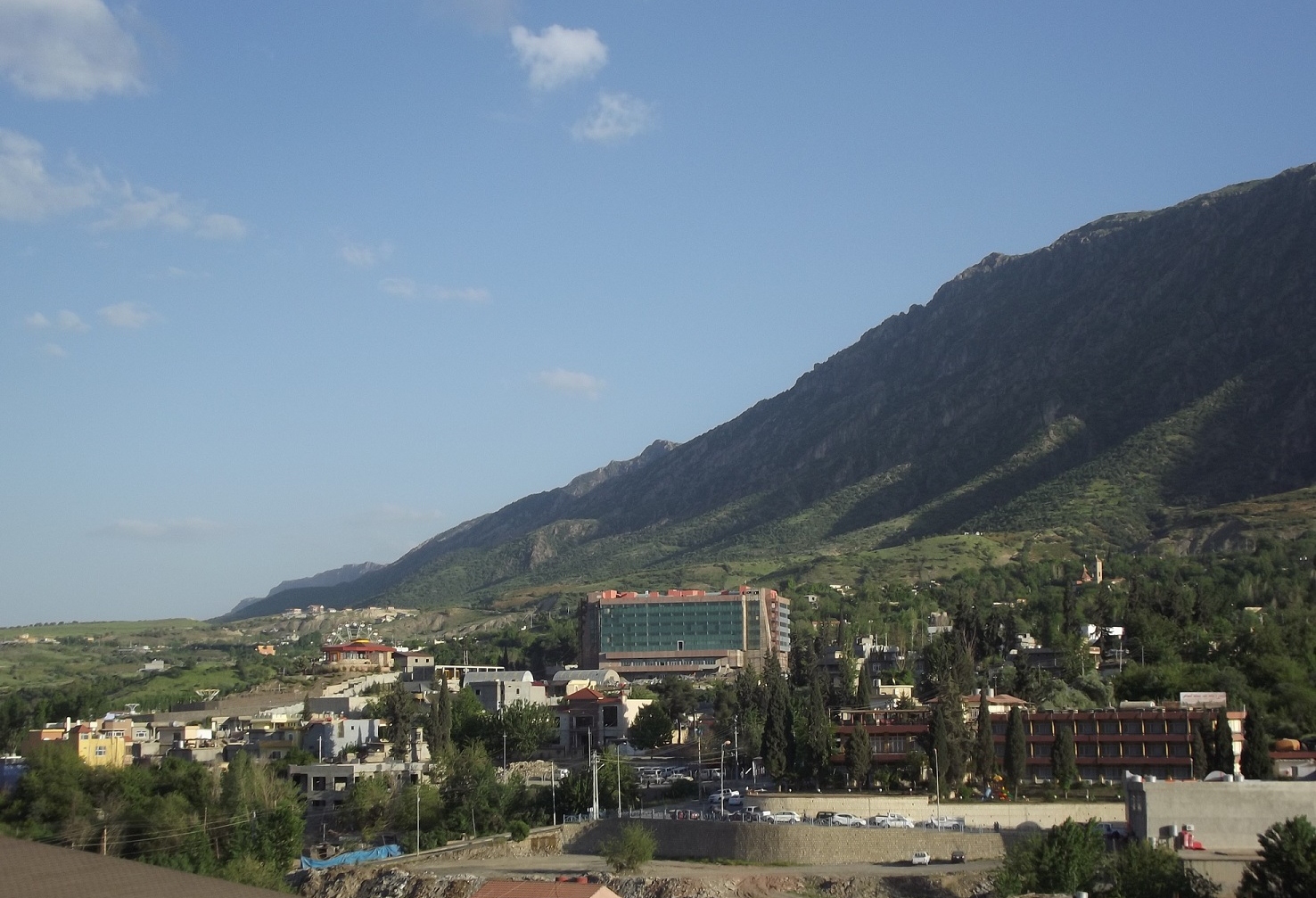
Photo: Copyright Sweden and the Middle East Blog
I love to show Iraqi Kurdistan in photos, because it proves that a country or region can build itself up from a broken past and turn into a beautful place.
To Kurdistan now Iraqis from Baghdad and Basra go for vacation, to get away from the violence and unstability in the South. It used to be the other way around.
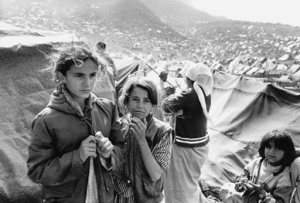
Photo credit: WOMEN NEWS NETWORK
This article is published in an edited, Swedish version in the feminist magazine AstraNova’s October issue 2013.
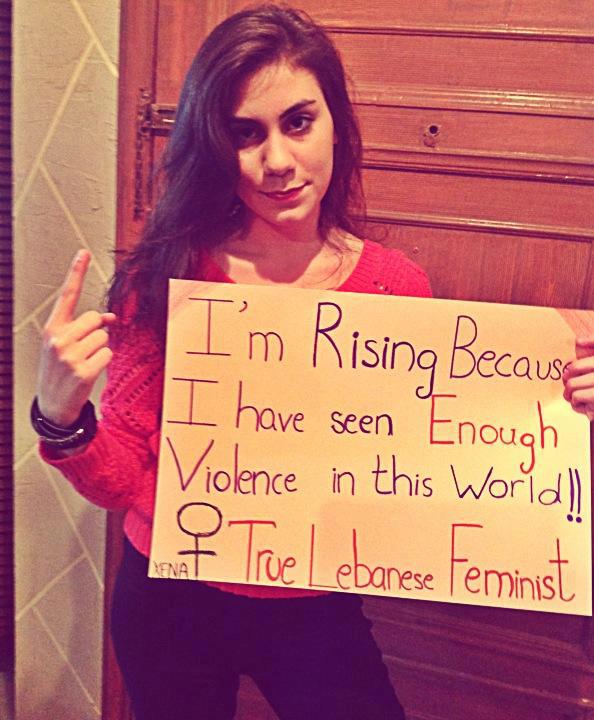
When Xena Amro started the True Lebanese Feminist Facebook page in July 2012, it created turmoil. Xena’s own Facebook page had been reported and blocked several times, so she wasn’t surprised. On her desk in high school, random insults were written in the beginning of her school year: “Xena is stupid”, “Lesbian”, “Feminism sucks ass”, reads the messages that she shows to me when we meet at Starbucks in Beirut, pictured on her smartphone.
Why was it so provoking to her fellow students that Xena was an outspoken feminist? Was it because of the success of her page? Or was it because of her uncompromising position? “I am a feminist, because those ignorant rapists out there, have limited my Freedom! They have ruined my childhood! And made me lose my mental innocence!” says one post from September 2012.
Despite the harassments in school and on the Facebook page, Xena kept up her page and now it has over 6.000 followers. She has support from both men and women, and she says she loves it especially when men become feminists:
“That’s what’s keeping me strong” she says.
Xena became a feminist early in 2012 when she was one of the winners in a competition for young writers, on the topic “In Lebanon”. “True Lebanese Feminist” was the story’s name and it was chosen to be in the top 12 list nominated for the prize. After the story and the competition, it was impossible to look back.
Xena explains on how stories about domestic violence reached her and that the general suppression against women was what made her become aware at such a young age.
“The purpose of the page is to raise awareness about women’s issues not just in Lebanon, but also globally” she says. “There are too many stereotypes placed on women that I want to fight against.”
I started to follow the page myself in the beginning and have seen it explode in to what must have been a previous vacuum, where a similar feminist page didn’t exist before. On Facebook there are many pages for women’s rights, but few that create as much discussions. What makes the page different is also that when someone attacks Xena or her statements she often don’t reply, but let the discussion have its course, relying on her supporters on the page, and makes a point out of not insulting anyone back.
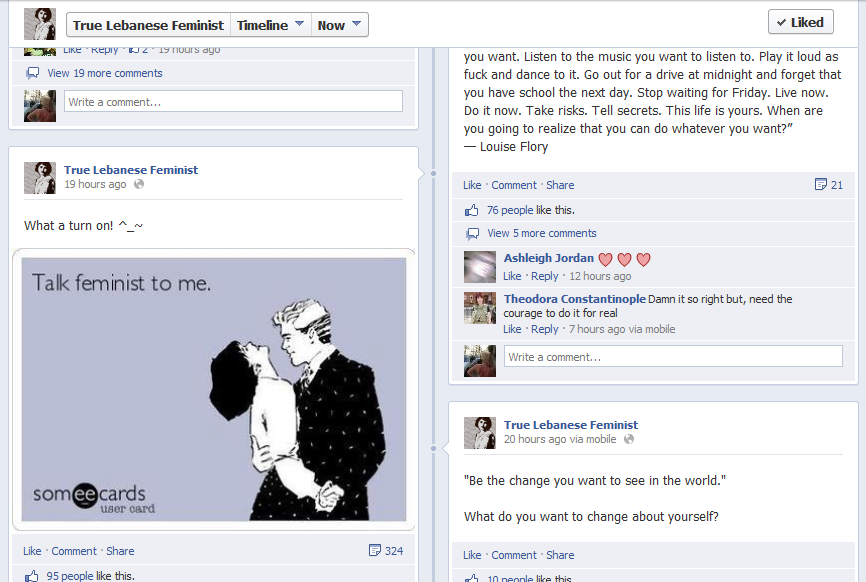
Every day the self-taught 17-year-old Xena updates the page with pictures combined with quotes; invites the followers to discussions; and shares other women’s stories. Female Arab writers like Joumana Haddad and Nawal El Saadawi inspired her. The numbers of followers quickly increased and the page turned into a place full of heated discussions. Not shying away from any subject, Xena brings up religion, sexuality and mass media from a feminist point of view:
“Today is the international day for safe abortion!” reads a post with a link to “Women’s Rights to Abortion in Lebanon”
“True?” over a photo that states “Girls see over 400 advertisements per day telling them how they should look”.
“Calling myself an outspoken dictator wouldn’t get me as much hate as I’m getting for calling myself an outspoken feminist” says another one.
Despite being as provocative in a society as Lebanon, one of Xena’s goals is to increase the number of Lebanese people on her page – out of 6,000 followers only 528 are from Lebanon (in comparison with 1,532 from US). It might not be a coincidence since her posts on religion and its links to patriarchy provokes many, and she has been accused of being a westernized atheist that hates religious people – a quite harsh insult in a society where religion plays a crucial role. Still Xena wants her page to stay relevant in her own country.
“I don’t hate religious people” she says. “They have the right to think whatever they want, and so do I – this is freedom.”
Since the beginning also emails for help has poured in. Many women from different countries have been writing to her about violence and rape, desperate for support, probably not knowing Xena is only 17. Xena takes her time to answer all emails, urging girls and women to seek help and not to feel ashamed.
I ask her how she handles it all. On top of managing the page on her own and the publicity it has given her, she gives feedback to all the members writing to her, and is also trying to finish high school to hopefully be admitted to nursing school this year. She admits that her parents, although very supportive of her feminist page, are worrying about the toll it might take on her grades.
“It takes all my free time… But the page is not pressure, it’s relief. I see a lot of injustice in the society, and I don’t want to hold these grudges in my heart.”
Photo credit: Xena Amro

Street in the area of Hamra, Beirut, Lebanon

Photo: Copyright Sweden and the Middle East Blog

I saw Maryam Aljooan in Kuwait Science Club, holding a presentation for an enthusiastic group of young Kuwaitis, for the first time back in 2008. The club was located out in the desert, far away from residency areas and shopping malls. A bleak building from the outside, colorful posters describing the earth and models of the planetary system decorated the inside. Small, claustrophobic stairs led to the roof where a telescope offered opportunities to watch the stars at night. The place was a refuge for young, smart people who wanted to do something else but shopping or eating. In weekends the members went on star watching trips to the desert and gathered to watch space related movies.
Maryam was the supervisor. Her main interests were space, earth and environment; she had studied engineering in US, one year in Russia at St Petersburg Polytechnical University; and was dedicated to share her knowledge.
“In Kuwait I met many young people that say ‘it’s not possible here’ about anything. There’s a lack of believe in themselves” she says.
Kuwait is a wealthy country where oil, expats and American-style malls have put the country on the map for many. But Maryam’s own childhood was characterized by the Gulf War, when the quiet little country suddenly was invaded and subject to horrible abuse by Iraqi troops. She retells how the society changed afterwards into a hopeless place. Many had lost family members; with the Iraqi army targeting the young boys, almost every family lost at least one of their sons.
“Before the invasion we had a little farm in our school, we did music and learned about arts. After the war everything was put aside.”
According to Maryam, materialism replaced curiosity and involvement in the community. The influence of American culture brought fast food chains and malls popped up with food courts and imported designer clothes, adding to the growing consumer culture. In a few years obesity had become a general health problem (today Kuwait ranks number 1 in obesity internationally). Many young people had lost hope and saw no importance in accomplishing. Everyone’s goal seemed to be to finish school and getting married. In her own family, there was no history of education: own father had only finished high school and her mother had dropped out when she was 12.
“My grandmother didn’t really care about my mom’s education; she wanted my mom to help out with her younger sisters and brothers at home.”
Her grandmother had herself no schooling at all and had been married off in her early teens.
It might not have been likely that Maryam would continue at university; she also went to a public school, not one of the high-ranking American or British private schools. She retells how her family, although being kind and even accepting her marrying a European man, never encouraged her, and she didn’t tell them her dreams about being an astronaut – she nurtured the dream since receiving a small telescope and books about space when being a small girl. In school she was shy and didn’t know how to do things on her own, and until the last year of high school she didn’t know that there was something called university or scholarships to apply for. When her class went on a tour to the university she was surprised: “Oh, there’s something more”, she remembers thinking to herself.
Now she started to wonder if it possible for her to pursue her studies in the space field. A scholarship made it possible for her to move to US to study her bachelors degree, and a NASA conference in 2003 made her decide what she wanted to work with.
“Space, earth and environment are all connected,” she explains to me with enthusiasm on Skype from Belgium, where she lives with her husband Alex, whom she met on a space conference in Japan. “I want to contribute to science and do something for climate change.”
For long she wanted to be the first female Arab astronaut in space and kept an acclaimed blog about it. But her involvement in the Kuwaiti community took a lot of time; she became the supervisor of the Department of Astronomy and Space Sciences at Kuwait Science Club and dedicated her free time to help the young members, at the same time she was travelling a lot and starting up her own NGO Lazurd (Arabic word for Azure, a hue of blue representing earth). She also put her efforts in to being the first Kuwaiti woman to go to Antarctica, and succeeded. Photos of Maryam with penguins; Maryam triumphantly holding up the Kuwaiti flag on an ice berg; Maryam in a small boat on her way over the chilling sea, fills up her Facebook page “The Antartic Expedition of Maryam Aljoaan”.
I ask her why she is so dedicated to the young people in Kuwait now that she has a career of her own and is living outside of the country.
“I was in this situation myself that I see many of the young people in today. If I wouldn’t do anything for the young people in Kuwait I would feel like I would disappear. I know I can set my own example for the kids.”
If she would be able to help another woman to be the first Arab woman in space, she would now appreciate this as much as being the first one herself. I ask her what her parents think about her, the shy girl from a public school who became a celebrity in Kuwait; the supervisor of Kuwait Science Club; and the first Kuwaiti woman on Antarctica.
“My mom is proud” she says. “And as for my dad, well he don’t talk much, but when I was in Russia he made a point out of calling me when he was in the Diwaniya” (gathering at someone’s house). “‘I’m speaking to my daughter, she’s in Russia! She’s studying space engineering!’ he would tell his friends. That’s how I know he’s proud of me too.”
Photo credit: Maryam Aljooan
 Sweden and the Middle East Views