“Dream of Dawn” – Music Video from Gaza

To all music lovers: the Gaza group Typo Band’s song “Dream of Dawn”, in Arabic with subtitles in English. Watch the beautiful footage in the video, hear the song and in case you don’t speak Arabic, read the poetic lyrics as you listen.

Change the common concept of love and freedom

Don’t leave it the way it is

Write on people’s hearts: ‘I exist’

Tear the fear out of their souls with your kind look

Write on people’s hearts: ‘I exist’

“You as a Woman are Guilty Until You Prove the Opposite” – The Execution of Reyhaneh Jabbari

taz.de

Reyhaneh Jabbari

As Reyhaneh Jabbari was hanged yesterday, the 26-year old Iranian woman convicted of stabbing a man who tried to rape her, international media filled up with stories about the unfair trial and the torture Reyhaneh supposedly was exposed to before being sentenced.

Reyhaneh claimed that she met Morteza Abdolali Sarbandi in a coffee shop and after he asked her to come to his office to discuss a business deal, he tried to rape her, why she in selfdefence stabbed him with her pocket knife before fleeing. Her lawyer reportedly published on his blog about the unfair trial against Reyhaneh as a plea for help, there were media campaigns against Reyhaneh’s execution, but the media attention didn’t help. After 7 years in prison, for which under some time she was prevented from contact with her family and from having a lawyer, she was hanged in Gohardasht prison in Teheran on the morning of Saturday October 25.

I asked an Iranian man that I know who’s living outside of Iran how he felt about the hanging, and he had many things to say. These are his words:

“Reyaneh has basically been considered guilty to one thing, and that is that she has defended herself as a woman. In many ways you as a woman are considered to be guilty until you in some way prove the opposite. ‘Evidence’ is here quite an irrelevant word.”

He talks about how the police in Iran are not conducting proper forensic investigations, and that facts is not important in the judicial system.

“If the judge thinks she is guilty for whatever reason,  she is guilty no matter what the circumstances are. It’s also ridiculously humiliating that Reyhaneh’s family have to ask the man’s family for mercy so that they shall spare her life. In this way the system is positioning one family against another. It’s not about proportion, facts or the right to defend yourself, but simply about a system that wants to prove that you as a woman shall not defend yourself and that you don’t have the right to a fair trial. But these kind of cases are not uncommon in Iran, there are worse… In the bigger picture this is not surprising. In Isfahan women have had acid thrown on their faces. This is just one case of many.”

Photo credit: taz.de

Sahab – Swedish-Iraqi Counselor with a Different Approach

When Sahab Saheb started her therapy service Authentic Dialogues she had decided that she wanted to offer counseling in three languages: Swedish, Arabic and English. At 32 years old with a master’s degree in social work and sexology, she wanted to offer her counseling services to such a wide range of clients as possible.

“There’s a challenge in working in different languages,” she says. “But I wanted to use my full potential.”

I wanted to write about Sahab not only because of her interesting character as a Swedish-Iraqi woman, but also since her approach to counseling seemed different. According to her, psychological counseling should be accessible and of low cost. Based in Malmö, Sweden, she also offers counseling via Skype, and on her website, under description of fees, it states: “Fee reductions are available for people on low incomes and this can be negotiated on an individual basis”.

The aspect of wanting to reach out to the many Arabic speaking people in Sweden is not a coincidence. In her master thesis Sahab researched an integration project for Arab immigrants, where she examined factors that determined the effectiveness of the program. The thesis published this year and is titled “Transformation of newcomers, responsibilities and consequences. An evaluation of the project ‘Newcomers, Shortest path’” (Malmö University, Faculty of Health and Society, Department of Social Work). The research gave her new insights in the world of social work and psychological assistance. Through the research she met many immigrants who tried to integrate themselves in Sweden and learned about the challenges they faced.

“The most important aspect is the gap between the experience from the home country and Sweden. The main difference between the two countries is the role that the state plays. People from the Middle East, Syria for example, come from a society where the state has a very negative reputation. People associate the state with fear and betrayal, and it’s not responsible for the individual’s welfare and personal development. Here in Sweden, the state is in charge of everything and a lot of mistrust is going on (from the newly arrived immigrants, my comment) that the Swedish authorities have no clue about.”

In contrast with some other Western countries, where immigrants that have received asylum are left on their own to find housing and work, sometimes with help from voluntary organizations, Swedish authorities offer a roof-over-the-head-guarantee and financial assistance until the person is able to provide for him. However, the choices of where to live or what to do (financial assistance requires the person to take part of mandatory Swedish classes or work programs in return) become reduced to a minimum when being dependent on the system, which many are until they have learned enough Swedish to manage on their own.

Having seen the clash between the Swedish society and the newly arrived immigrants and how the society sometimes fails to help people who suffer from traumas and psychological illnesses, Sahab wanted to create her own service instead of being part of the system.

“The professionalism of the Swedish bureaucracy has a distanced approach to people, and this approach is by many immigrants perceived as something personal against them, it becomes the only thing that the immigrant experience during the first years in Sweden. Even if we have to carry out the integration aspect through the institutions, since this is the way it works in Sweden, we have to implement more of a personal reception since these persons come from a society where there are stronger bonds between people. We shouldn’t dehumanize people the way the system sometimes does now.”

Still, the failures of the system served as an incentive for her to contribute with what she believed would be the best way to help people with psychological problems from experiences of war and terror.

“Instead of being bitter over the fact that I can’t implement what I think is right, I wanted to start my own thing to help people in a way that I believe in”, she says. “If we learn how to be more empathetic we’ll have better dialogues and a stronger society.”

The therapy Sahab offers is based on the existential humanistic psychology, which she says pays respect to people’s own inner potential and responsibility for their actions.

“I wanted to work with counselling that derives from an equal dialogue between the therapist and the patient. I believe that an illness in the society is that we don’t communicate between each other. I believe that this therapy is very helpful since you can carry it with you the whole life and apply it to new relationships. In the therapy you help people to have more confidence in themselves so that they can take more initiative and thereby enhance their own self-esteem.”

She emphasizes that it’s still important not to see people as solely traumatized and damaged individuals, since people have a lot to offer that you can encourage and build on.

“You also have to be very careful in how you create a dialogue with people who come from traumatized societies,” she says. “This therapy is non-directive, there is no right or wrong, it’s up to the client how he or she thinks. I believe this is very important in a multi-cultural society where people have different values. This will create less guilt and insecurity.”

I ask her how she deals with people that might have twisted or reversed values as they come from countries where war or a repressive state have been prevailing for so long that it affects the persons and their personal values. What does she say to them if they have internalized what they have seen and for example believe that violence is justified?

“Even if I tell this person that this and that is wrong it won’t help him if he doesn’t realize this himself.  We need to understand why the person has chosen to believe in this, because it’s a defense mechanism. And the less we use our defense mechanisms, the more we get out of life.”

She adds:

“I believe in this small effect. If we help one person, we will also help many others that will exist down that person’s road.”

So what is her dream with her service, which she recently started earlier this year? She laughs when I ask the question.

“I don’t believe that much in dreams, I believe in being present in the moment and enjoy that. I try not to be too much in the future, my challenge right now is to be able to assist people in need of help. And well… maybe sometime in the future I’ll be able to work together with other people, who want to work in the same way I do.”

Photo copyright: Sahab Saber

To get in touch with Sahab please visit her website: authenticdialogues.com

Ay hawar! Hawar! Hawar! (HELP US! HELP US! HELP US!)

A number of my Kurdish, Iraqi and Syrian friends in the countries and abroad are horrifyed of the ISIS terror, and at times are unable to talk about anything else. A number of websites and social media pages are dedicated to launch news about the terrorists so as to create awareness and ask the world for help. Today I stumbled upon a heartbreaking message from a Facebookpage that is updating with news from Kobane in Northern Syria that is under immense threat of being abducted by ISIS. I thought I should share their message and let it speak for itself.

From: Kurdish Resistance & Liberation community 

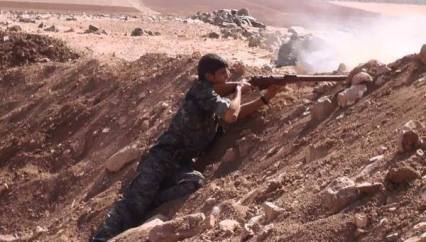
Our hearts are breaking at the moment. Kobane is under serious siege at the moment and our brave YPG/PKK forces are left to fight with outdated and limited weapons on the streets of Kobane. Kobane has a strategic, symbolic and psychological significance for the Kurds, but the lack of help from the west and lack of arms to the Kurds is allowing ISIS to succeed! An imminent genocide of the Kurdish forces as well as civilians is on the horizon all because they do not have the appropriate military supplies. The Kurdish forces have been fighting non stop for the past 48 hours. SHAME on the West for your inaction while these brave men and women die defending humanity, defending civilians, women and children and defend the West from ISIS. Shame!

Friends PLEASE share so that the Western community realizes that if Kobane falls it was not for lack of trying on behalf of the brave YPG/YPJ/PKK forces. It was because of Western cowardice and THEIR betrayal of humanity!

Ay hawar! hawar! hawar! (HELP US! HELP US! HELP US!)

kurdish resistance 2

Kurdish resistance 1

Photo credit: Kurdish Resistance & Liberation Facebook page, source and location unknown

Iraqi Womens’ Petition to the White House to Act Against ISIS

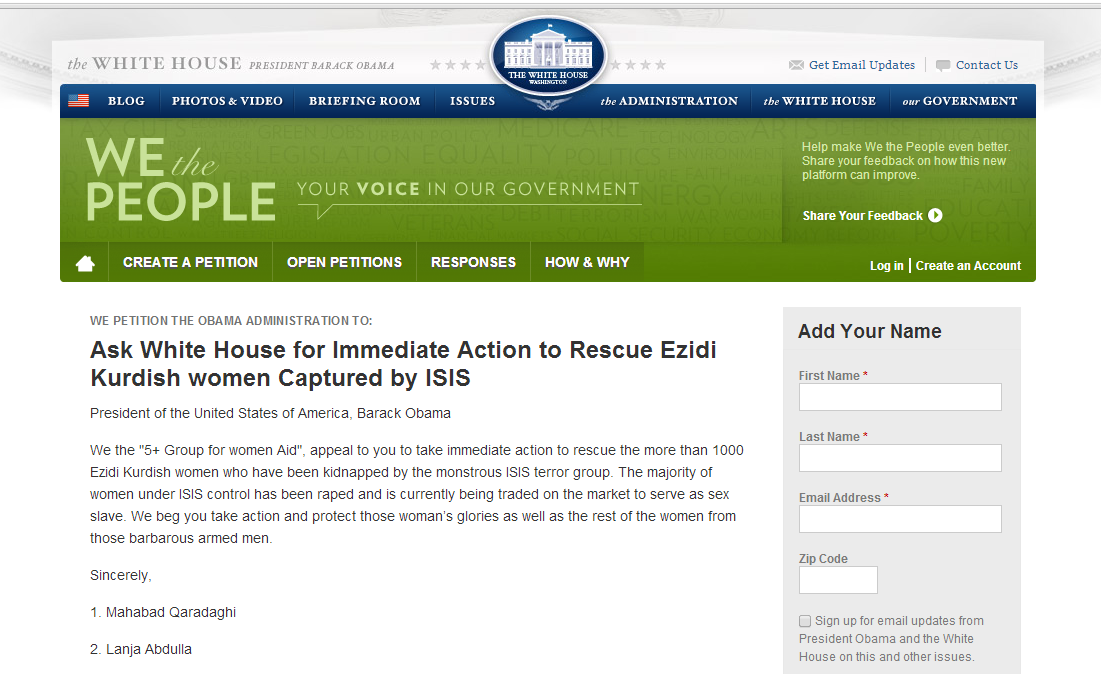
I’m reluctant to what kind of international support Iraq and Syria are needing in the ongoing crisis of ISIS, as I as most other people don’t want to see previous disasters repeated all over again. But tonight my friends the women’s right activists at Warvin Foundation for Women’s Issues in Iraqi Kurdistan e-mailed me about a petition that they have signed for the White House, where they ask them to take immediate action to rescue the kidnapped Yesidi Kurdish women from ISIS, and I had a look.

The petition says:

We the… appeal to you to take immediate action to rescue the more than 1000 Ezidi Kurdish women who have been kidnapped by the monstrous ISIS terror group. The majority of women under ISIS control has been raped and is currently being traded on the market to serve as sex slave. We beg you take action and protect those woman’s glories as well as the rest of the women from those barbarous armed men.

This isn’t some foreigners wanting to liberate women in the Middle East, it’s not a bombing campaign noone asked for. This is Iraqi women asking for help for their fellow citizens that are enslaved under conditions you don’t want to imagine. At least I don’t want to imagine. That’s why I decided to share this with you.

How Do You Become an ISIS Terrorist?

ISIS or ISIL or IS – they are so creative in their name changings, I have to give them that – has startled the whole world it seems with their ambitious brutality. The Iraqi military just gave up their weapons and ran, despite the years and years of trainings from American experts, trying to compensate their invasion. The Kurdish Peshmerga tried to hold the fort but failed. But should we really have been so surprised?

I won’t discuss what a failure it is for Iraqi intelligence not to recognize the threat of ISIS, nor will I discuss the exclusion of minorities from the Iraqi government and the consequences it has had. This blog post will go back in time, and ask how these young men became ISIS terrorists in the first place.

How can a normal human being become attracted to such a merciless, murderous organization with no respect for humans what so ever, not even for their own kind? ISIS is not Al Qaida who will spare Muslims, they’re not the “good Talibans” of Pakistan, they’re a group of young men who supposedly sell women as sex slaves and twitter about it; who make children die of dehydration on a mountain. They don’t seem afraid of dying themselves. It is as if they had no attachments of their own, nothing to relate to but the darkness inside of them.

Let me start my trail of thoughts by telling you what I know of Iraq before the invasion. I’m not Iraqi, I have just lived there, and I’m not claiming to take an Iraqi’s place. I will just give you my impressions.

Iraq did not have a solid welfare state, well how many countries do?, and many rural areas were neglected under the long era of the Saddam regime. But there was an educational system, universities free of tuition fees and complimentary dorms for male and female students, making it possible also for women to gain an education away from home. In the cities there were governmental orphanages. Women were able to work and access public life. Religious freedom and coexistence was something to take for granted (no, I’m not bringing in Kurdistan in this discussion, because it’s not affected by the civil war that followed the invasion). In southern and central Iraq there was peace.

After 2004 not only bombs tore the country apart. Neighbors turned on each other, people started disappearing; regular civilians with no political connections. Corpses were dumped by the roads. Internally displaced people crowded the streets. Child-headed households became a new phenomenon. Child prostitution sky rocketed. A women’s rights NGO I worked with once received a teenage girl asking for help, who had been a prostitute since she was a child. She didn’t know who her mother was or why she had been left at the brothel so young. But it could have been anything – in a collapsed society you don’t always find a reason. The girl didn’t know how old she was, and at the brothel they called her different names.

“What is her real name?” I asked when hearing about the case.

Also this she didn’t know. She had no name.

Now imagine you’re a boy growing up with these reversed values around you. Where there once had been moral guidelines and a public condemnation if you did something considered wrong, fear and hatred has now taken its place. If you’re unlucky these reversed values seeps in to your family, creates enemies between family members because of religion, or closes the door to their own family in need of help. An Iraqi boy I once knew had his parents murdered by the Al Sadr militia and as a response his uncles made him sleep on the street.

“If you come here, they’ll come after us too,” his uncle said to the teenage boy who was left on his own.

But if you’re worse off you’ll have no family at all and you won’t know why, like the child prostitute without a name.

Time passes and you’re a frightened boy growing in to a young, angry man. And you might turn whatever madness that was around you to your defense. You have no education, no background, no family, no attachments. What was once wrong becomes right.

Are my ideas clear, did my message come through? If it was hard to grasp, here’s the short version:

ISIS shouldn’t have taken us by such surprise. We have created this monster ourselves.

Photocredit: Sweden and the Middle East Views Blog

Hawzhin The Middle Eastern Feminist

Hawzhin Azeez

The Middle Eastern Feminist page singled itself out from other feminist pages on Facebook when it started up in December last year. Feminism across boundaries of ethnicity and nations; love over hate; support over anger, seemed to be the red threads for the page.

If you are struggling today, remember that you were never meant to be ashamed, depressed and guilty. You were always meant to be victorious! Don’t let the bastards grind you down,” says a quote followed by a heart from July 16.

The reconciling approach seemed to appeal to many. The page soon had many followers.

Often white, middle class women are blamed for having this approach to women’s rights as they haven’t faced real hardships themselves. But the woman behind The Middle Eastern Feminist page is not one of those.

Hawzhin Azeez’s early childhood memories consists of escaping Iraqi Kurdistan as Saddam Hussein bombed the area with chemical weapons; her pressing a scarf against her face not to breath in the lethal smoke; her mother having skin burns all over her. Living as illegal refugees in Iran the family sometimes didn’t eat for days, and on a regular basis the police came and took away her father, accusing him of being a part of the resistance against the Iranian regime due to his Kurdish ethnicity. The family never knew when or if he was coming back. In this setting there was no room for women’s rights.

“When growing up in a refugee setting, in war-torn countries, it’s incredibly hard being a woman,” says Hawzhin when explaining her upbringing and how she became a feminist. “People hold on to their ethnicity and as a young woman you’re just supposed to behave.”

After finally receiving asylum in Australia, Hawzhin and her family faced a new dilemma: the one of suddenly being in a liberal culture with new gender roles that they had no idea how to manage.

“I was going through my puberty in a family traumatized from the war,” Hawzhin says. “And we were stripped off our identity. My parents were very traditional and conservative and it was difficult for me to be friends with Australian girls. It was an isolating experience going to a Western school.”

In the Kurdish community where they lived a strong social control was being exercised. Hawzhin points out that it was first and foremost the women who exercised this control over each other and each other’s daughters. She says they had internalized the racism and sexism they had been exposed to as Kurds in the Middle East, and turned it into misogyny.

“Gossip was used a tool to limit and control each other between women. It was used to shame and guilt what women and girls did in the community.”

Despite the lack of role models, Hawzhin knew she was a feminist.

“I was born a feminist!” she says. “In Iran I witnessed things that were incredibly wrong and unjust. Religion was used as an ideology to limit the women, what they wanted to achieve. What chador means for me as a human being is that I become sexualized.”

As a teenager she was incredibly angry because she wasn’t able to live her life the way she wanted to. She read a lot of feminist literature in high school, it was her escape.

“My choices were directly linked to my family, if they agreed. I couldn’t create any issues for my family in the Kurdish community. It was a constant struggle between the community’s values and my feminism.”

Despite having arrived to Australia as an 11 year old with only two years of primary school education, Hawzhin was able to enter university after high school to study international relations and political science. But even having made it so far, she couldn’t live the way she wanted to. When she moved out of her parents’ house to do her PhD in another city at 25 years old, she was finally able to be independent. But it took a long time for her to adjust.

“I had no idea who I was. Growing up in a patriarchal family I had been constantly told how to behave and how to live. I now choose to live independently and I wish for every girl to have this freedom. Unless you do this you will never be able to make informed decisions on yourself.”

When starting The Middle Eastern feminist page it was after a long and difficult semester at university, when she was emotionally drained and spent a lot of time in front of Facebook. She noticed how people mostly posted things about what they ate and going to the gym, and wanted to turn her Facebook time into something more intellectual. Her motivation also steamed from being back in her country of origin for the first time since the escape. She went on her own without her parents and met up with her relatives. The trips were wonderful, she says, but she noticed how little women in Iraqi Kurdistan knew about their rights, and this was something she wanted to change.

“I wanted a safe place for Middle Eastern women or women from developing societies where they could talk about their rights and issues they were dealing with. But I also wanted to challenge them and tell them they could have a traditional life and still be feminists.”

Hawzhin mean that some women in the Middle East might not be able to escape their traditional life but that they can find space where they can still be feminists.

Another goal was to educate Western women on Middle Eastern women’s issues. She wanted a place for women from the two worlds to meet and realize that they were dealing with the same issues.

“Women everywhere are dealing with for example street harassment. Although the issues Middle Eastern women have are on another level, we are all struggling. I wanted to create a place for solidarity, for women to find commonalities in their lives.”

“Have you felt supported by Australian feminists or have you felt excluded?”

“Feminism in Australia is not a priority for many people… There is also a barrier between privileged women and women of color. A lot of the feminist groups and women are diffused within the political movements, there are not many groups trying to bridge the gap between privileged women and women of color, to bring all of these different identities together. But this is necessary.”

The page is now an active place for discussions and many of the over 6.000 followers are not only from the Middle East but from all over the world. Through the page connections are being made and people are making friends across boundaries. Hawzhin is actively promoting other feminist pages on her own, urging her followers to like a new page that has recently been started. She’s also sharing her private Facebook page with followers that want to add her as a friend – a page where she has posted photos of herself and her mom hugging, dressed up in Kurdish clothes, as well as photos from university parties where she’s dolled up (“I dress very femininely, I love to wear lipstick,” she says on a side note).

On combining the different cultures, she says that she sees herself as a bridge between women in Afghanistan who can’t leave the house, and urban, developed women in Egypt; that they can contribute to each other through the page.

A long message to her followers on the page from July starts like this:

I haven’t said this in a while, but: I am so incredibly in love with all you inspiring feminists (male and female), and the new ones on this page and the ones that send me private emails and share their stories, and those of you who comment and make witty and brilliant comments to posts. I know that we all come from different cultural and social settings but that does not take away from the fact that we are all struggling against a global system which thrives on the oppression and subjugation of people based on their gender or sexual orientation or race. All of our struggles matter, though the problems we face may differ somewhat.

Hawzhin has had very little negative feedback on her page and says she is shocked by the amount of support and number of women that have been contacting her. Some people expect that she’s a Muslim feminist but this is not what she calls herself.

“I call myself a secular feminist,” she says. “But if women want to cover up that’s great – I don’t believe in ripping women off their scarf.”

“Does your family know you’re a feminist?”

She laughs:

“Oh yes, very much so.”

So how are her parents, the once traumatized refugees that had such a hard time to adjust to the new society they were in, dealing with their daughter having developed to being such an outspoken feminist?

“My family has come such a long way,” she says, delighted. “There were so many things we couldn’t discuss before due to our culture, but this has changed. I am now teaching my younger sister and brother about feminism. When I visit them I always show them feminist documentaries, and my sister who is 13 comes with me to political marches. I’m teaching her to be more independent. It’s important to start with the children.”

Photo 1: Copyright Hawzhin Azeez, Photo 2: Copyright Sweden and the Middle East Views Blog

Young Angry Men

angryman

Stereotypes of young angry men are often used in order to incite fear of the other – that other that is so scary to us for reasons we might not know ourselves. This is a disease so common we don’t reflect upon it. Why was for example Trayvon Martin’s murderer released if it wasn’t for that justifying fear?

I’ve been afraid myself: growing up in the capital of Sweden didn’t spare me from class related tensions, often connected to ethnicity or color, and riding on the subway made me subject of things such as sexual harassment and girls spitting me in the face. I was a blonde middle class girl for all they knew and an easy target for whatever anger they needed to vent. And yes, I was afraid of young men, especially of color, who seemed angry.

Later on when I was grown and graduated university I worked as a substitute teacher while I hoped a job opening would come through. I took on jobs in the projects as the social aspect of teaching appealed to me. The job contained a lot more of steering off violent teenagers and spending time on the phone to the social services than what it contained teaching, and it was draining at times but I was dedicated and stayed on. In one school I had a particularly violent student, one of those who would have scared me when I was younger, a 13 year old boy that we can call Mostafa.

On good days Mostafa was happy with merely stabbing a sharpened pen in his school desk while repeating every word the teacher said in a mocking voice. The whole school seemed to be afraid of him. I dreaded classes with him but always tried to keep my cool. That plus a dose of discipline and kindness was my way of dealing with the students.

“I’m gonna destroy your presentation, you fucking bitch!” was one of his opening lines, to which I usually replied “Oh, really”, which always left him puzzled for a few seconds.

But despite our efforts to teach the kids we teachers never asked ourselves what the anger came from. We didn’t seem to have the energy to do the math of alienation, substandard housing, poverty. Isn’t that the fault of the whole society?

Now Mostafa was the child of immigrant parents from a Middle Eastern country and I mentioned once to the students that I had lived in his parents’ country of origin. Mostafa didn’t comment upon it but other kids asked me of the few words I had picked up in Arabic and Mostafa overheard it all. One day he banged on the door and demanded to be let in when I was preparing a class. He positioned himself on a desk and started to talk to me about his parent’s home country, as if he wanted to verify that it was really true I had lived there. We had a small conversation where he asked questions such as “Did you have friends there?” (“Yes, I did”), before he went out again.

After that day he slowly changed his behavior in my class. He stopped mocking me when I spoke. He stopped throwing things across the classroom. He tried to finish his exercises and left his desk to show me that he was writing (“Great, Mostafa. You’re doing really well”). Then the school semester came to an end, so did my temporary contract and the next semester I was teaching at a different school.

One evening there was a festival in our city and I was out with a friend to listen to some live music. When we approached the hiphop scene I suddenly heard a teenage voice calling my name:

“Jenny, Jenny!”

It was Mostafa, whom I hadn’t seen since the end of the last semester. He had spotted me from the audience stage and suddenly stood above me.

“Hi Mostafa!” I answered with a smile, pleased to see him.

Back then I often – and I still actually do – ran in to former students who were happier to see me outside school than they had ever been seeing me inside of it. When bumping in to each other downtown many wanted to talk a little and tell me about their lives; some simply said hi; the most hardcore ones usually just nodded in recognition or ignored me. Not wanting to talk was to me understandable, as some of them dropped out of school and joined gangs, and this is nothing you want to admit to your former teacher. But nothing of what I could have expected had prepared me for Mostafa’s response that day: he jumped off the stage, threw himself in my arms, and buried his head in my shoulder. Perplexed I hugged him for a few amazing seconds.

“How are you? I’m fine! I gotta go!” He said all in once and then freed himself from my embrace, suddenly realizing what he had done; the hug of a former teacher in front of his friends, then set off and ran away.

I never saw him again, later on I heard that he was one of the kids to drop out of school, but I will never forget the hug that day. It changed my previous perception of young and angry men. In that very moment, the angry Mostafa whom everyone was so afraid of, was nowhere in sight.

Photo credit: mahwaff.com

What Mandela Meant to My 5-year-old Me

Can I tell you what Nelson Mandela meant to my 5-year-old me, back in the early 80s?

Once my sisters and I were shopping with our dad in the grocery store. He didn’t want to buy the apples from South Africa, asking us to choose from the other shelf instead, and we demanded to know why. And so he started to explain.

There was a country far, far away, where some people were treated differently than the others. Therefore us in other countries should not buy their things, so that they would understand what they did was wrong. This was a tricky thing to explain for three small girls with one million questions, but dad didn’t give up.

“It would be like… if Maria (their friend’s daughter) wouldn’t be allowed to sit on the same bus as you”, he explained, as he trailed us through the store with a shopping cart filled with unflavored cereal and other boring groceries that characterized Sweden in the 1980s. “Or if someone was sick, and the hospital wouldn’t let them in.”

The story haunted me. A few years later the front pages posted the news on Mandela’s was release. One of my friends’ father explained what the headlines were about, as we passed by the placards.

These stories must have affected my in a way I didn’t realize. And yes, feelings of anger and sadness followed as a result of knowledge. But I am glad adults were willing to take their time explaining things, instead of sugarcoating it. Small things like these shaped me into the person I am today. It made yesterday, to me, a special day.

First Saudi Policewoman Ever to Graduate!

ayat bakhreeba

Yesterday the world suddenly became a little better place to live – a Saudi woman graduated from the Dubai police academy, and according to the news she is the first Saudi woman ever to become a police officer!

Leaving few traces of herself online and unknown to international media before her graduation, Ayat Bakhreeba did not only become the first Saudi police officer ever. According to Riyadhconnect.com and other Gulf media, Ayat Bakhreeba is graduating in public law with a thesis research on children’s rights in the Saudi regime – a brave subject in a totalitarian regime. For a country that systematically discriminates women and children, this woman is taking a small step on the moon; which is a big step for humanity. Not that I’m surprised with the Saudi women, not at all. Things are shaking up in the kingdom.

Photo credit: Emirates247.com